Structure of the Cluster and Pedicel
Following fertilization and berry set, the inflorescence develops into a cluster (bunch), and the inflorescence axes transform into the rachis (Fig. 38). Mechanical and vascular tissues proliferate within the rachis branches, while the expansion of soft phloem ensures an abundant flow of plastic substances to the berries.
A grape cluster consists of the peduncle (cluster stem), the rachis (winged or conical), and the berries (Fig. 39). The peduncle bears a node up to which it typically lignifies. Each berry is attached to the rachis by a pedicel terminating in a receptacle (torus) that abuts the berry directly. When a berry is detached from its pedicel, torn vascular bundles remain attached to the receptacle, forming a "brush" (Fig. 40, 41).
Berry Development and Skin Structure
The berry develops from the flower ovary: after egg fertilization, the growing embryo stimulates the proliferation of ovary wall tissues (pericarp). Initially, volume increases through cell division, vascular bundle formation, and tissue differentiation; subsequently, growth proceeds via cell wall expansion. During the differentiation phase, the berry remains green, possesses functional stomata with living guard cells on its surface, and actively assimilates.
The berry pericarp is differentiated into three distinct layers (Fig. 42):
- Skin (exocarp/epicarp) — the outer protective covering consisting of 10–15 cell layers. In most cultivars, the skin is coated externally with a protective epicuticular wax bloom (pruin). The outermost cell layer (epidermis) contains apertures for gas exchange: in green berries, these function as stomata, which later suberize and convert into lenticels visible on ripe berries as minute brown dots.
- Pulp (mesocarp) — the middle tissue composed of greatly enlarged ovarian cells filled with cell sap. Beneath the skin lies a network of peripheral vascular bundles connected to the main axial bundles entering from the rachis through the pedicel and central pulp.
- Core (endocarp) — the innermost layer of the pericarp, derived from the ovarian septum and directly surrounding the seeds.
Following rainfall, rapid expansion of the skin in ripe berries causes berry splitting in certain cultivars, leading to fungal rot and reduced crop quality. Mechanically, the skin may be thin and easily torn (barely perceptible when eaten) or thick and tough. The skin contains small quantities of aromatic and flavor compounds (the majority are distributed throughout the pulp) that impart characteristic varietal taste and aroma.
Berry Pigmentation
Berry coloration ranges from nearly black to milky-white and translucent. It is governed by the composition of pigments and anthocyanins in the skin cell layers (from the epidermis down to the eighth layer), the number of pigmented layers, and their depth, as well as pigmentation of the cytoplasm, cell sap, and specialized anthocyanin-rich vacuoles (anthocyanoplasts).
- Differing cell sap pigmentation across distinct skin layers produces gray berry tones.
- Uneven pigment distribution causes striping or sunburn ("tanning") on the sun-exposed side.
- In light-colored cultivars, the wax bloom modifies the apparent hue; additionally, color intensity depends on climate and soil (for example, on the Southern Coast of Crimea, white Central Asian cultivars develop a pinkish tinge, while pink cultivars turn red).
- Pulp cells generally lack pigments, with the exception of teinturier cultivars (Teinturier, Saperavi, VIR 1, etc.), whose pulp cell sap contains anthocyanins.
Pulp Consistency and Technological Properties
Based on consistency, berry pulp across cultivars is classified as juicy (melting), fleshy-juicy, fleshy, mucilaginous (slipskin), or firm (crisp). These differences result from the degree of cell wall thinning and mucilaginization during ripening:
- In juicy-pulped cultivars, cell walls are extremely thin, rupture easily upon crushing, and yield free-run juice readily.
- In fleshy and crisp-pulped cultivars, cell walls are thick and rigid, yielding less free juice.
- Uneven mucilaginization occurs, for example, in the cultivar Isabella: peripheral cell layers beneath the skin have thin walls and abundant juice, whereas inner cells surrounding the seeds are fleshier and form a cohesive mucilaginous pulp mass that slips out intact along with the seeds.
In most cultivars, seeds separate easily from the pulp; in others, they adhere firmly. The physical and mechanical properties of the skin and pulp determine must yield, ease of pressing, and wine quality.
Types of Berry Seedlessness
A grape berry may contain one to four seeds, though seedless berries also occur. Seedlessness in grapevines is divided into two biological types:
- Parthenocarpy (shot berries / millerandage) — ovary development into a berry without fertilization or embryo formation. Such berries are small and spherical. Many cultivars exhibit partial parthenocarpy (normal seeded berries and small seedless berries coexist within the same cluster), particularly pronounced in cultivars with functionally female flowers under unfavorable pollination conditions (Chaouch, Madeleine Angevine, Nimrang, etc.). In the cultivar Black Corinth, the entire cluster consists of parthenocarpic berries. Cultivars incapable of parthenocarpy shed all unfertilized ovaries when pollination fails.
- Stenospermocarpy (seedless raisin-type / kishmish) — berry development following fertilization and initial embryo growth, with subsequent abortion of seed development at an early stage. A small, soft-coated seed trace (rudiment) remains inside the berry. The developing embryo stimulates pericarp growth, allowing the berry to attain its characteristic oval or elongated varietal shape (Kishmish Belyi Ovalnyi, Kishmish Chernyi). Certain clones of Kishmish Belyi bear both oval stenospermocarpic and spherical parthenocarpic berries within the same cluster.
Structure of the Grape Seed
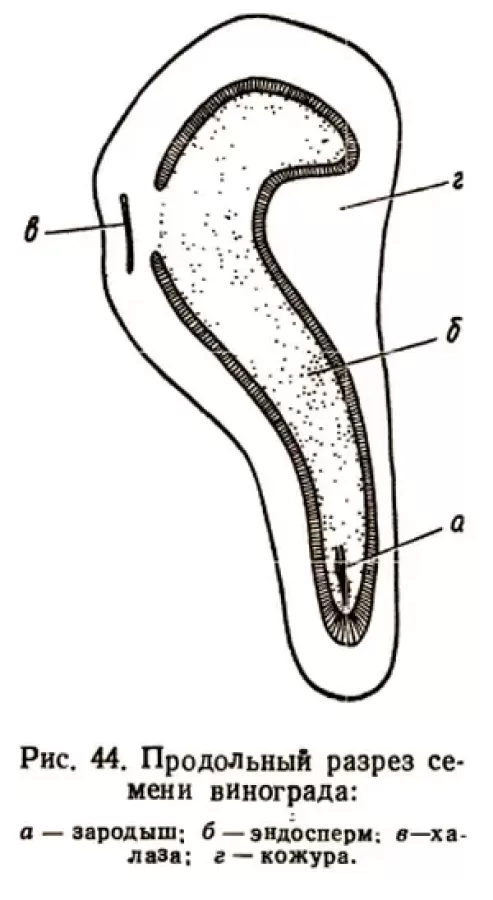
A grape seed consists of a hard seed coat (testa), endosperm, and embryo (Fig. 43, 44):
- Seed coat is composed of sclerenchymatous (stone) cells rich in tannins.
- Endosperm consists of cells packed with reserve nutrients (proteins, lipids, etc.) that nourish the embryo during germination.
- Embryo is situated in the beak of the seed and contains primordia of all vegetative organs: two cotyledons, the plumule (epicotyl bud) between them, the hypocotyl transitioning into the radicle with a root cap, and procambial strands of the future vascular system (Fig. 45).
Externally, the seed exhibits a ventral (inner) and a dorsal (outer) face (Fig. 43). The ventral face bears the raphe (seed ridge) and two longitudinal depressions (fossettes), while the dorsal face bears the chalaza (the point of entry of vascular bundles into the seed).