The grapevine plant possesses vegetative organs (root, stem, leaf) and generative organs (inflorescences, flowers, clusters, berries, seeds).
Physiological Functions of the Root
The grapevine root performs six primary functions:
- absorbs water and mineral substances from the soil, conducting them through the stem to the leaves and generative organs;
- converts absorbed inorganic nitrogen compounds into organic forms (as established by Soviet researchers);
- transforms mineral phosphorus into organic phosphorus and absorbs carbon dioxide from the soil, which the plant utilizes alongside atmospheric carbon dioxide entering the leaves (studies by A. L. Kursanov et al.);
- enriches the soil with organic matter upon decomposition;
- serves as a storage organ for reserve nutrients (starch, proteins, fats);
- anchors the plant in the soil (mechanical function).
Root activity is directly linked to the aerial part of the vine. The reduction of mineral nitrogen and phosphorus to organic forms occurs in the roots with the participation of carbohydrates synthesized in the leaves during photosynthesis. The accumulation of nitrogen, phosphorus, and carbon in the form of proteins promotes the formation of generative organs. High grape yields depend on the coordinated activity of leaves and roots.
Root System Composition and Young Root Zones
The aggregate of old skeletal roots and young roots forms the root system. Old skeletal roots are covered with cork and serve to conduct water and nutrients, store food reserves, and provide mechanical anchorage. Young white short roots (rootlets) absorb water and mineral elements; the synthesis of organic compounds occurs primarily within them.
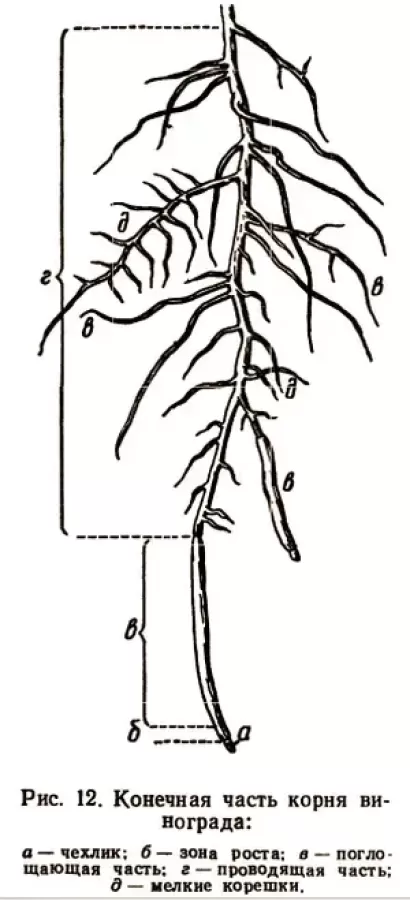
The root terminates in a growing point (apical meristem), where cell division and formation take place (Fig. 12). The root tip is protected by a root cap. Above the elongation zone lies the absorbing zone, 1–2 cm in length, which exhibits a primary anatomical structure.
Primary Anatomical Structure of the Root
In the absorbing zone, the root consists of the following tissues (Fig. 13):
- Epidermis — the outer layer of uniform, tightly packed cells, some of which elongate to form root hairs.
- Intercutis — the outermost layer of cortical cells located directly beneath the epidermis.
- Cortical parenchyma — 10–25 layers of cells lying beneath the intercutis. Individual cells contain raphides.
- Endodermis — the innermost layer of the cortex, composed of cells with thickened walls.
- Central cylinder (stele) — the inner core of the root, consisting in a young root of 2–3 primary vascular bundles in which strands of primary xylem and primary phloem alternate. Externally, the bundles are surrounded by several layers of parenchymatous cells — the pericycle ("root-generating layer"), from which lateral roots originate.
Root hairs penetrate between soil particles and enter into exchange reactions with the soil-absorbing complex. As the root grows, older hairs die off and are replaced by new ones. Soil microorganisms (bacteria, fungi) play a major role in these exchange reactions, converting unavailable forms of soil compounds into readily assimilable forms. The grapevine also possesses internal and external mycorrhiza — a symbiosis between grapevine roots and the hyphae of soil fungi.
Each year, the grapevine forms numerous young roots that explore new soil volumes, proliferating most actively in zones with favorable conditions.
Root Shedding and Transition to Secondary Structure
Simultaneously with the formation of new roots, older, spent roots naturally die off — a process known as root shedding. Skeletal roots are the most long-lived. Young roots undergo secondary changes in their second year, while their tips continue to grow. Fine rootlets are less durable, and root hairs live for 10–20 days. Surviving fine rootlets, which are fleshy and white during their growth phase, gradually become suberized, turn brown, and become significantly thinner (Fig. 14).
The transition of the root to a secondary structure involves the following processes:
- Cambial activity. A continuous layer of meristematic cells — the vascular cambium — forms between the phloem and xylem within the central cylinder. Initially star-shaped in cross-section, it soon assumes a circular outline. Through continuous division, cambial cells produce secondary xylem (wood) inward and secondary phloem (bast) outward, both intersected radially by pith and vascular rays. Annual cambial activity increases root thickness and forms annual growth rings of xylem. Within the secondary phloem, the cambium produces alternating thick-walled and thin-walled elements of hard and soft bast.
- Bark formation. Simultaneously, endodermal cells undergo suberization, causing the entire primary cortex to dry out and gradually slough off. A ring of secondary meristem — the phellogen (cork cambium) — develops from the pericycle cells. All tissues external to the phellogen dry out and form a cork layer. Each year, new rings of phellogen arise within the secondary cortex, producing successive layers of bark (rhytidome).
Seasonal Dynamics of Root Growth
Grapevine roots lack an innate dormancy period: under favorable conditions, they can grow year-round. Like other perennial plants of the temperate zone, grapevine roots grow for a significantly longer period than shoots and exhibit two peaks of intense growth: spring–summer and autumn (Fig. 15). During hot, dry summer periods and in winter, root growth weakens or ceases.
The seasonal activity cycle of the root system proceeds as follows:
- Onset of spring activity: begins when soil temperature reaches 7 °C. At this stage, water is absorbed by brown rootlets formed the previous autumn, which lack a white absorbing zone. According to Prof. A. S. Merzhanian, fungi (mycorrhiza) living both in the soil and inside the cells of the root cortical parenchyma (endotrophic mycorrhiza) play a major role in spring water uptake.
- Onset of spring growth: axial root growth begins after budbreak once soil temperature reaches approximately 10 °C. Mass growth and branching of active roots start later, when the soil warms to about 15 °C. Spring–summer root growth supplies the vine with water and nutrients during shoot elongation and crop development.
- Autumn growth and winter accumulation: autumn root growth continues until November, after shoot growth has ceased. Throughout winter, nutrient accumulation and synthesis (particularly of nitrogen) occur within these autumn-formed rootlets, providing essential reserves for spring inflorescence differentiation and the onset of vegetation.
Root System of Seedlings and Grafted/Own-Rooted Cuttings
The degree of development of the grapevine's subterranean part largely depends on the planting method and pre-planting soil preparation (Fig. 16).
In seedlings grown from seed, the entire underground part consists exclusively of roots: a single taproot develops alongside lateral roots of the first, second, and subsequent orders. A distinct transition zone — the root collar — is present between the stem and the root.
In plants propagated from cuttings, a root collar is absent; instead, the plant possesses an underground stem (trunk) bearing adventitious roots. The architecture of a cutting's root system depends on cutting length and planting technique:
- Planting a single-bud cutting produces one, two, or several taproot-like main roots with lateral branches.
- Planting a long multi-bud cutting produces roots primarily at the nodes, with the highest concentration forming at the basal node (heel).
According to B. S. Ermakov and V. G. Ermakova, adventitious roots in cuttings originate in the peripheral cells of the primary medullary ray (adjacent to the bast portion of the phloem and pericyclic fibers) and, under favorable conditions, also in the proliferated undifferentiated multicellular cambium, secondary phloem parenchyma, and primary cortical parenchyma.
Root Development on the Underground Trunk and Role of Branching
In the upper portion of the underground trunk, where favorable temperature and moisture conditions arise in spring, superficial "dew roots" develop. They often grow weakly and die off by autumn. The main root system develops from the lower and middle nodes of the underground trunk.
As the vine ages, a portion of the main roots dies off: while approximately 40 main roots may be present in the first years after planting, their number decreases to 6–7 in subsequent years. Concurrently, the number of third-, fourth-, and higher-order roots increases. Studies by Prof. P. T. Bolgarev established that the higher the degree of root branching (and thus the greater the number of root tips and total root length), the stronger the shoot growth and the higher the vine yield.
Rooting Depth and Lateral Spread
Rooting depth varies according to climate, soil conditions, viticultural practices, cultivar, and vine age (Fig. 17). In northern regions, the root system develops closer to the soil surface; in southern, particularly arid regions, roots penetrate deeper in search of moisture. Where gravel beds, groundwater, or impenetrable subsoils lie close to the surface, root development is confined to the topsoil layer. The lateral spread radius of grapevine roots ranges from 2–3 m to 4 m or more.
| Region and Soil Conditions | Rooting Depth |
|---|---|
| Primorsky Krai (shallow impenetrable subsoils) | 15–30 cm |
| Moscow Oblast | 20–40 cm |
| Odesa (southern chernozems, main root mass) | 45–60 cm |
| Dnieper Sands | up to 140 cm |
| Southern Coast of Crimea (clayey shale soils, vines aged 50–65 years) | 2.5–3.5 m (individual roots up to 8 m or more) |
| Uzbekistan (irrigated serozems) | up to 6–8 m |
Grapevine roots are fleshy and contain a substantial proportion of living tissues. Medullary and vascular rays are powerfully developed, storing large quantities of reserve nutrients. Studying root system architecture and growth periods at a specific site enables the selection of appropriate pre-planting soil tillage as well as optimal fertilizer placement depth and timing.