Aleatico
| Variety Passport | |
| Country of origin: | Italy |
| Variety number VIVC: | 259 |
| Prime name: | Aleatico |
| Principal Synonyms: | Aleatico Nero, Uva Liatica, Moscatelle Livatiche |
| Species: | Vitis vinifera |
| Ripening period: | Late |
| Classification and Use: | Wine, Dry Table Wines, Dessert and Sweet Wines, Fortified and Liqueur Wines |
| Resistance group: | Susceptible |
| Data Sources: | Vitis International Variety Catalogue (VIVC), Сорта винограда (Е. Н. Докучаева изд. 1986) |



| Agrobiology | |
| Vigor: | Vigorous |
| Flower type: | Hermaphrodite |
| Downy mildew susceptibility: | 4 points (susceptible) |
| Powdery mildew susceptibility: | 4 points (susceptible) |
| Botrytis susceptibility: | 4 points (susceptible) |
| Winter hardiness: | Non-hardy (-15...-17°C) |
| Fertility coefficient: | 0,7 |
| Bud fertility index: | 1,4 |
| Percentage of fruitful shoots: | 45% |
| Pruning length: | Medium, 5-8 buds |
| Recommended rootstocks: | RR 101-14, 41 B |
| Clusters and berries | |
| Bunch shape: | Cylindro-conical, Winged |
| Bunch density: | Medium, Dense |
| Average bunch weight: | 130-140 g |
| Berry shape: | Rounded |
| Berry skin color: | Black |
| Average berry weight: | 1,5-1,8 g |
| Seed development: | Seeded |
| Flesh texture: | Juicy |
| Berry skin thickness: | Thick |
| Berry skin texture: | Tough |
| Sugar content: | 20-26% |
| Total acidity: | 5,5-6,5 g/l |
| Berry Flesh Color: | Non-colored |
| Juice yield: | 83,6% |
| Flavor type: | Muscat |
| Ampelographic overview |
Main Characteristics
Aleatico (synonyms: Aleatico Nero, Uva Liatica, Moscatelle Livatiche) is an Italian wine grape variety belonging to the Western European ecological-geographical group. It is widely cultivated in its homeland of Italy and is also found in the USA and the USSR (Dagestan, Central Asia, RSFSR). In the Ukrainian SSR, the variety is zoned in the Crimean region.
The Aleatico grape variety is characterized by a late ripening period: 164 days pass from budbreak to harvest maturity at a sum of active temperatures of 2946 °C. Berry ripening occurs in the third decade of September. The yield of the variety is high but unstable: according to data from the Henichesk State Variety Testing Plot (1957–1963), it amounted to 76 c/ha without irrigation and 171 c/ha with pre-winter irrigation.
Clusters are medium-sized (10–16 cm long, 8–10 cm wide), cylindro-conical, dense or moderately loose, and sometimes winged. Cluster weight is 130–140 g. Berries are medium-sized (13–16 mm in diameter), rounded, black, with a bluish waxy bloom. The average weight of 100 berries is 150–180 g. The skin is thick and tough; the flesh is juicy and greenish. The flavor is pleasant with a faint muscat aroma, and the juice is colorless. Each berry contains 1–3 seeds.
Morphological Description of the Aleatico Grape Variety
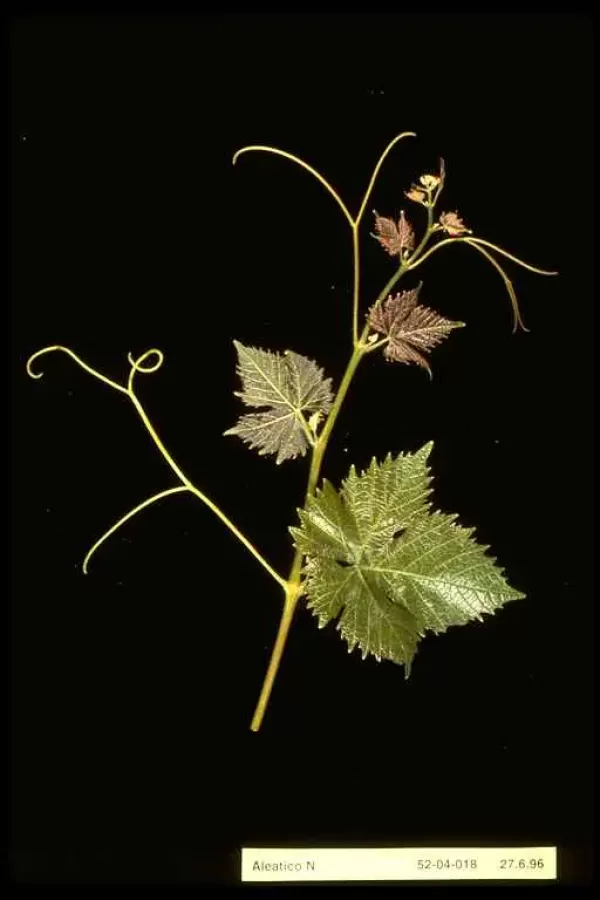
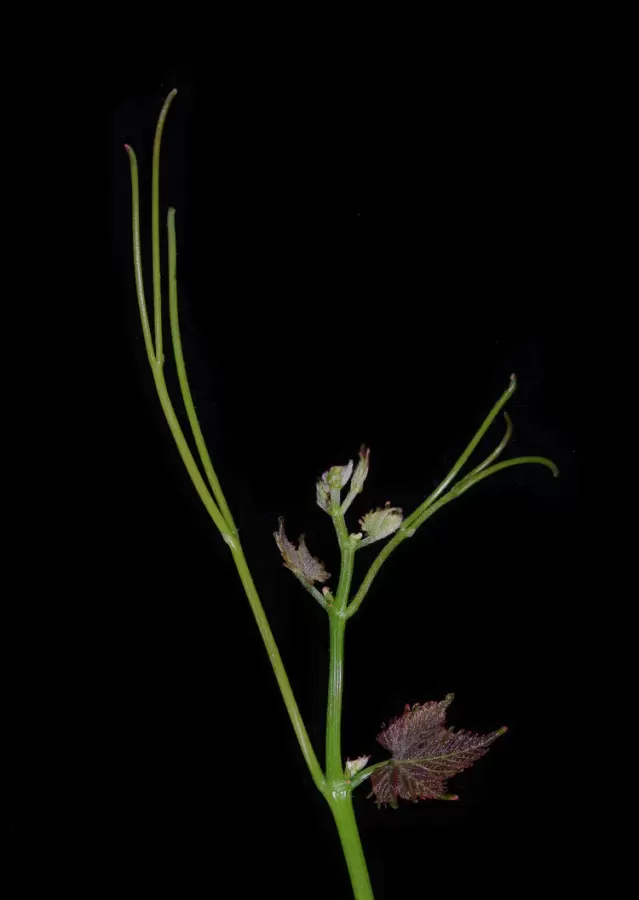
- Young Shoot Tip: moderately pubescent, light green, with wine-red teeth. Young leaves are medium-lobed, with a bronze margin and sparse cobwebby pubescence.
- One-Year-Old Mature Shoot: yellowish-brown.
- Leaf: large, rounded, medium- to deeply-lobed, 3- and 5-lobed, dark green. Pubescence on the lower leaf surface is absent or very sparse and bristly. Autumn leaf coloration is yellow with reddish spots.
- Sinuses and Petiolar Sinus: upper lateral sinuses are medium-deep and deep, closed with an elongated-ovate lumen; lower sinuses are shallow and open. The petiolar sinus is closed with an oval lumen or open and lyre-shaped.
- Teeth: terminal and marginal teeth are triangular and sharp.
- Flower: hermaphrodite.
- Cluster: medium-sized, cylindro-conical, dense or moderately loose, with a short peduncle (3 cm long).
- Saplings: low-vigor with sprawling shoots. Apical leaves are glossy with crimson spots, while subsequent leaves are weakly lobed; their lateral lobes are raised, and lobe margins are curved downward.
- Key Identifying Traits: leaves with small, sharp, saw-like teeth and a somewhat elongated central lobe folded into a trough; cylindro-conical clusters; rounded, black berries with a faint muscat aftertaste.
Agrotechnical Features
Vines of the Aleatico grape variety are vigorous with upright shoots; shoot ripening is satisfactory. Fruitful shoots account for 45%. The average number of clusters per developed shoot is 0.7, and per fruitful shoot is 1.4. Shoots developing from secondary buds and on old wood are partially fruitful.
The variety is susceptible to downy mildew, powdery mildew, and crown gall, and is vulnerable to gray rot and phylloxera, though it is less damaged by the European grapevine moth than other varieties. In wet weather, inflorescences are frequently affected by fungal diseases. Aleatico has high heat requirements and does not tolerate low-lying areas, where the entire aerial part of the vine often freezes. The variety is sensitive to drought and responsive to irrigation.
On the Southern Coast of Crimea, plantations of the Aleatico variety are best sited on well-warmed slopes at the foot of mountains protected from northern winds, with gravelly, sufficiently moist soils. Under a bilateral cordon training system, short pruning is recommended, leaving four fruiting spurs of 4–5 buds each. Higher yields are obtained with a four-arm fan training system pruned to 6–7 buds per cane. Recommended rootstocks are Riparia × Rupestris 101-14, and Chasselas × Berlandieri 41B on calcareous soils.
Winemaking and Product Characteristics
The mechanical composition of the Aleatico grape cluster (% of total weight) is: juice — 83.6%, stems — 5.7%, skin and dense flesh parts — 7.5%, seeds — 3.2%. Juice sugar content at harvest reaches 20–26 g/100 mL with a titratable acidity of 5.5–6.5 g/L.
Aleatico grapes are used to produce the vintage dessert red wine "Aleatico Ayu-Dag" with a light muscat tone. In blends with Morastel, Cabernet Sauvignon, or Saperavi, it is used to make port-style wine characterized by oiliness, fullness, and a distinctive bouquet. The tasting score for dry wine is 8.4 points, and for dessert wine is 9.7 points.