Cardinal
| Variety Passport | |
| Country of origin: | USA |
| Variety number VIVC: | 2091 |
| Prime name: | Cardinal |
| Principal Synonyms: | Marokkoban, Francesa, Apostoliatiko |
| Year of obtaining / registration: | 1943 |
| Pedigree given by breeder: | Flame Tokay × Alphonse Lavallée |
| Pedigree confirmed by markers: | Alphonse Lavallee x Koenigin der Weingaerten |
| Species: | Vitis vinifera |
| Ripening period: | Very early |
| Classification and Use: | Table, Commercial sale, Fresh consumption, Long-term storage |
| Resistance group: | Susceptible |
| Data Sources: | Vitis International Variety Catalogue (VIVC), Сорта винограда (Е. Н. Докучаева изд. 1986) |


| Agrobiology | |
| Vigor: | medium |
| Flower type: | hermaphrodite |
| Downy mildew susceptibility: | 4 points (highly susceptible) |
| Powdery mildew susceptibility: | 4 points (highly susceptible) |
| Botrytis susceptibility: | 3 points (low resistance) |
| Root phylloxera susceptibility: | 4 points (highly susceptible) |
| Winter hardiness: | Non-hardy (-15...-17°C) |
| Fertility coefficient: | 0,9 |
| Коэффициент плодоносности: | 1,3 |
| Percentage of fruitful shoots: | 67% |
| Pruning length: | medium, 5-8 buds |
| Recommended rootstocks: | RR 101-14, SO 4, 41 B |
| Clusters and berries | |
| Bunch shape: | cylindro-conical |
| Bunch density: | very loose, loose |
| Average bunch weight: | 142-210 g |
| Berry shape: | rounded, oval |
| Berry skin color: | red |
| Seed development: | seeded |
| Flesh texture: | fleshy, firm / crunchy |
| Berry skin thickness: | medium |
| Berry skin texture: | medium |
| Sugar content: | 15,6-18% |
| Total acidity: | 7-8,4 g/l |
| Flavor type: | Muscat |
| Ampelographic overview |
Main Characteristics
Cardinal is a table grape variety of an extremely early ripening period. It was bred in California (USA) by breeder E. Snyder through the hybridization of the Flame Tokay and Alphonse Lavallée varieties*. The vegetative period from budburst to harvest maturity of the berries is 121 days, with a sum of active temperatures of 2308 °C. Berries ripen in the late first to second decade of August. The vines are characterized by medium vigor, and the wood maturity is satisfactory.
The Cardinal grape variety has a potentially high but unstable yield. The average cluster weight ranges from 142 to 210 g. The berries are very large, round-oval or oval, violet-red with a smoky waxy bloom. The pulp is fleshy-juicy, crisp, with a pleasant taste and a mild muscat flavor. The skin is relatively firm but tears easily. The sugar content of the berry juice at harvest is 15.6–18.0 g/100 ml, with a titratable acidity of 7–8.4 g/l. The tasting score for fresh grapes is high, at 8–9 points. The product is suitable for fresh consumption, as well as for making compotes and jams.
Morphological Description of Variety Traits
Morphological features of the Cardinal variety include:
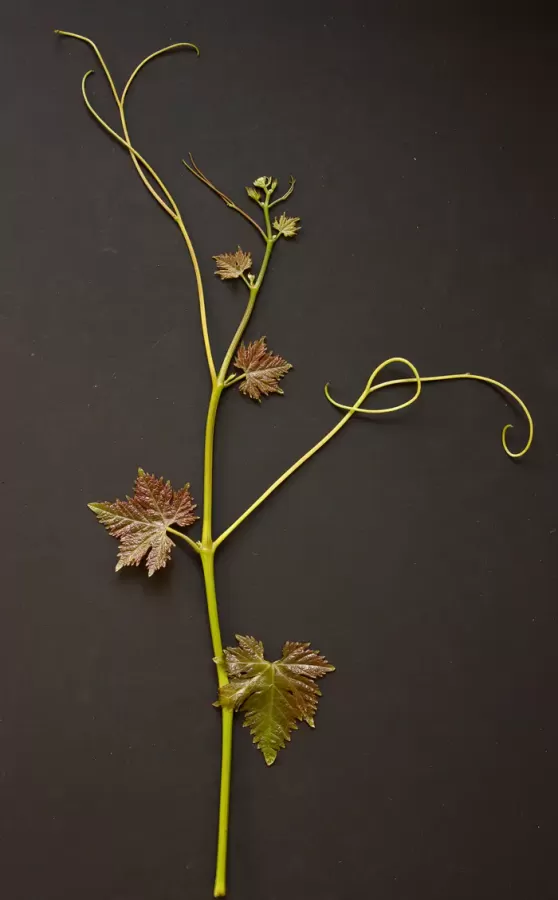
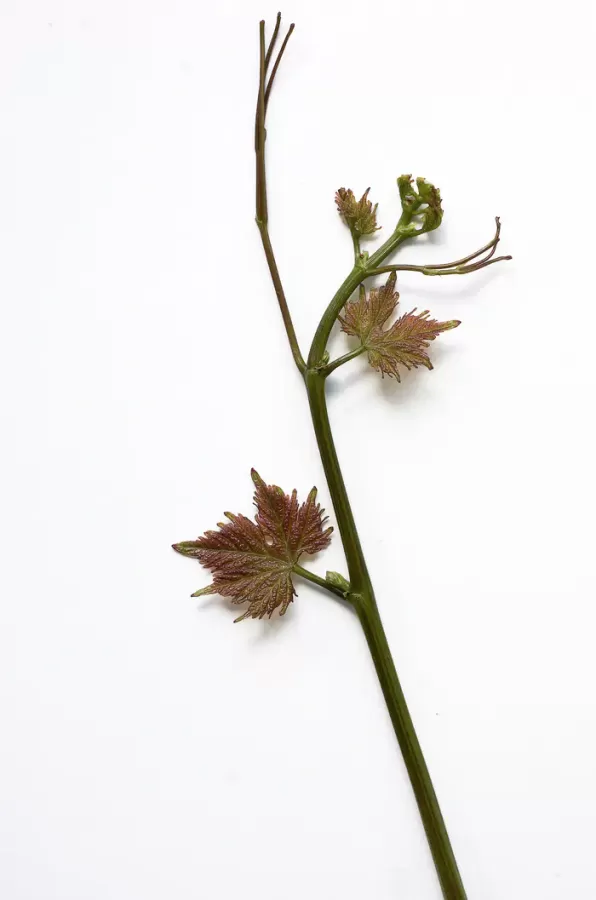
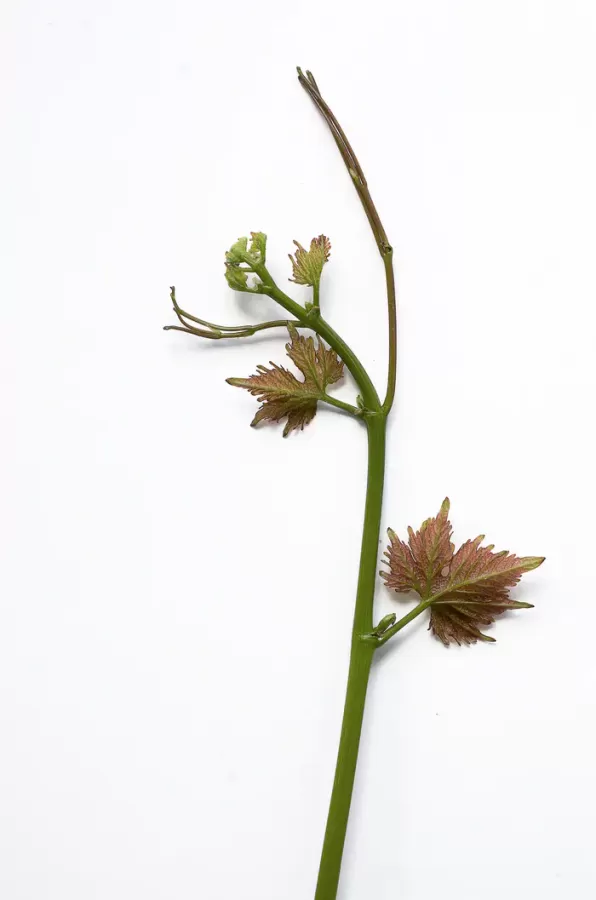
- Young shoot: The shoot tip (apex) and the upper young leaves are light green, without pubescence, with a faint bronze tint on the tips of the teeth.
- One-year-old mature cane: Bright brown, with dark brown nodes.
- Leaf: Large, round, moderately deeply cleft, five-lobed. The surface is glabrous, glossy, smooth, and sometimes slightly wavy. Pubescence is absent on both sides of the leaf. The autumn foliage color is yellow.
- Leaf sinuses: Upper sinuses are of medium depth to deep, mostly closed, with a slit-like or oval perforation. Lower sinuses are open, lyre-shaped, narrow, or in the form of incoming angles. The petiolar sinus is open, arch-shaped, and sometimes bordered by a vein on one side.
- Teeth: Terminal teeth are triangular, elongated, with rounded apexes and light borders. Marginal teeth are triangular with convex sides (almost dome-shaped) or saw-toothed.
- Cluster: Large (16–25 cm long, 11–18 cm wide), cylindrico-conical, loose or very loose in density. The cluster stem (peduncle) is long (6–8 cm) and green. The rachis is green and breaks easily.
- Berry: Very large (15–26 mm long, 9–16 mm wide), violet-red. It sometimes features a slanted apex with a small groove on it. The berries contain 2–4 large seeds.
Agrotechnical Features
The Cardinal variety is heat-loving. Its commercial cultivation is efficient in regions well-provided with heat, on southern and southwestern slopes with light loamy, sandy loam, and chernozem soils. The percentage of fertile shoots per vine is 67%, the fruitfulness coefficient is 0.9, and the fertility coefficient is 1.3. In years with unfavorable weather conditions during flowering, this grape variety shows a tendency to flower drop, shatter, and millerandage (shot berries).
For vines of this variety, a fan training system or a two-armed Guyot system is recommended, with a load of 25–30 buds and 13–16 fruitful shoots per vine. In the warmest regions, high-stem training (two-armed cordon on a high stem) is possible, combined with relatively short pruning, leaving no more than 5–6 buds per fruiting cane. Recommended rootstocks include: Riparia × Rupestris 101-14, Berlandieri × Riparia SO4, and Shasla × Berlandieri 41B for calcareous soils.
The Cardinal variety is highly susceptible to winter frosts and freezes. It is characterized by high vulnerability to oidium, downy mildew (mildew), bacterial canker, and gray rot of berries. It is also damaged by the European grapevine moth. The grapes possess high transportability and are suitable for long-term storage (up to three months).
\* VINEYARD Note: According to the results of DNA analysis, the claimed origin has not been confirmed.