Cinsaut
| Variety Passport | |
| Country of origin: | France |
| Variety number VIVC: | 2672 |
| Prime name: | Cinsaut |
| Principal Synonyms: | Malaga, Mavro Kara, Prunella, Madiran |
| Species: | Vitis vinifera |
| Ripening period: | Medium-late |
| Classification and Use: | Table, Fresh consumption, Long-term storage |
| Resistance group: | Susceptible |
| Data Sources: | Vitis International Variety Catalogue (VIVC), Сорта винограда (Е. Н. Докучаева изд. 1986) |



| Agrobiology | |
| Vigor: | Medium |
| Flower type: | Hermaphrodite |
| Downy mildew susceptibility: | 4 points (susceptible) |
| Powdery mildew susceptibility: | 4 points (susceptible) |
| Botrytis susceptibility: | 4 points (susceptible) |
| Root phylloxera susceptibility: | 4 points (susceptible) |
| Winter hardiness: | Non-hardy (-15...-17°C) |
| Fertility coefficient: | 1,1 |
| Bud fertility index: | 1,4 |
| Percentage of fruitful shoots: | 75% |
| Pruning length: | Medium, 5-8 buds |
| Recommended rootstocks: | Teleki 8B, Kober 5BB, RR 101-14, Couderc 3309 |
| Clusters and berries | |
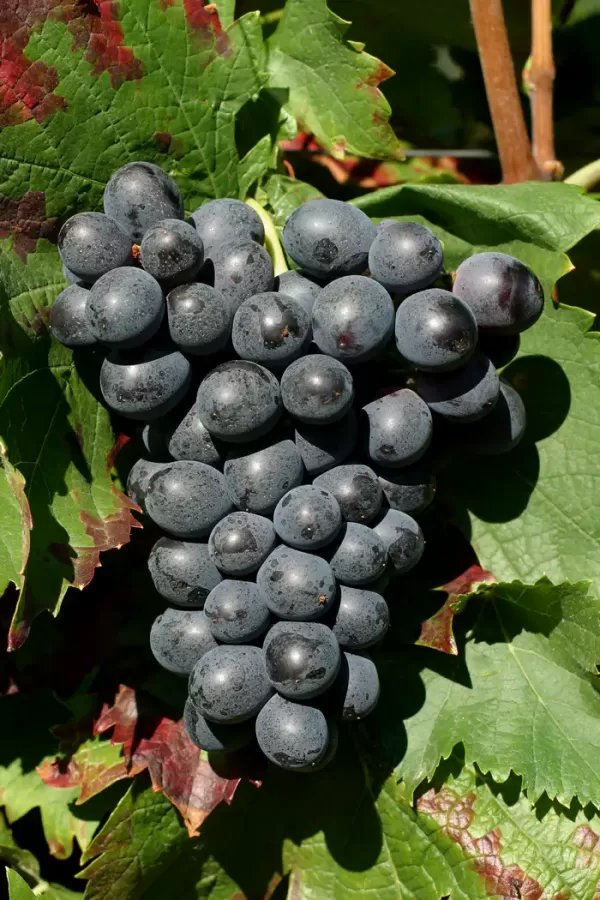
| Bunch shape: | Conical, Cylindro-conical, Winged |
| Bunch density: | Medium, Dense |
| Average bunch weight: | 154-210 g |
| Berry shape: | Oval |
| Berry skin color: | Black |
| Average berry weight: | 2,6-3,4 g |
| Seed development: | Seeded |
| Flesh texture: | Juicy, Fleshy, Firm / Crunchy |
| Berry skin thickness: | Medium |
| Berry skin texture: | Medium |
| Sugar content: | 16,4-17% |
| Total acidity: | 7,6 g/l |
| Berry Flesh Color: | Non-colored |
| Juice yield: | 84,4% |
| Flavor type: | Neutral |
| Ampelographic overview |
General Characteristics
Cinsaut (synonyms: Malaga, Mavro Kara) is a table grape variety found in plantings across Western Europe, Morocco, Argentina, and other countries. In the USSR, it grows in almost all viticultural regions, and in Ukraine it is released for cultivation in the Vinnitsa, Donetsk, Zaporozhye, Crimean, Nikolaev, Odessa, and Kherson regions.
In terms of ripening time, the Cinsaut grape variety belongs to the mid-late ripening varieties. From bud burst to harvest maturity, 148 days pass in Genichesk with a sum of active temperatures of 2855 °C, and 146 days in Odessa with a sum of active temperatures of 2870 °C; berry ripening occurs at the end of the third decade of September. The vines are of medium vigor, and one-year-old canes mature well.
Cinsaut is characterized by high and very high consistent yields. According to data from the Genichesk State Variety Testing Plot in the Kherson region, over a three-year average of full fruiting (1969–1971), the yield reached 10.56 t/ha (105.6 c/ha) without irrigation and 22.7 t/ha (227 c/ha) under partial irrigation (pre-winter watering). Cluster weight is 154–210 g, and the weight of 100 berries is 260–340 g. Juice sugar content at harvest reaches 16.4–17 g/100 ml with a titratable acidity of 7.6 g/l. The berry pulp has a pleasant, refreshing flavor, and the tasting score of fresh grapes is 8–8.6 points.
Ampelographic Description of the Cinsaut Grape Variety
- Young shoot (shoot tip): The shoot tip and the first leaves of the young shoot are nearly white from dense felty pubescence, with a wine-red tint. Subsequent leaves are yellowish-green with slight pubescence.
- Mature one-year-old shoot: Grayish-brown, with brownish-violet nodes.
- Mature leaf: Medium-sized, round, flat or slightly funnel-shaped, with grooved lobes, deeply or moderately lobed, five-lobed, featuring a characteristic reticulate-rugose (shagreen-like) light green surface. Upper lateral sinuses are of medium depth or deep, mostly open, lyre-shaped, with parallel sides, rarely closed with an elliptical lumen; lower sinuses are of medium depth, open, and lyre-shaped. The petiolar sinus is open and lyre-shaped. Apical teeth are long, triangular, and acute; marginal teeth are triangular with convex sides, or acute and saw-toothed. Pubescence on the lower leaf surface is arachnoid (cobwebby), and very sparse setose (bristly) along the veins.
- Flower: Hermaphroditic (bisexual).
- Cluster: Medium to large (16–18 cm long, 10–12 cm wide), conical, less frequently cylindrical-conical, occasionally winged/lobed, of medium density or dense. The peduncle is short (3–4 cm long).
- Berry: Large (18–20 mm long, 15–16 mm wide), oval, dark blue, with a heavy waxy bloom (pruine). The skin is of medium thickness, elastic, and tearing. The pulp is fleshy-juicy and slightly crisp; the juice is colorless. Each berry contains 2–4 small seeds.
- Nursery plants (saplings): With spreading shoots. The shoot tip is light green with a bronze tint; mid-tier leaves are funnel-grooved, with acute-triangular lobe teeth. Autumn leaf coloration is yellow with wine-red spots.
Viticultural Features and Resistance
The Cinsaut grape variety is distinguished by high fruitfulness: the percentage of fruitful shoots is 75%, with an average of 1.1 clusters per developed shoot and 1.4 clusters per fruitful shoot. The variety is capable of producing fruitful shoots from basal buds and secondary buds, and it is prone to overcropping, which leads to unevenly colored clusters and berries.
Cinsaut fruits well under a fan training system with arm lengths of 40–50 cm, a planting spacing of 2.5–3 × 1.25–1.5 m (L. T. Nikiforova, O. A. Martyanova, 1971), and a vine load of 35–40 buds and 25–28 shoots per vine (including 22–24 fruitful shoots). Canes are pruned to 5–8 buds. High-trunk cultivation is only feasible south of the minus 19 °C isotherm. Rootstocks recommended by the V. E. Tairov Ukrainian Research Institute of Viticulture and Winemaking include Berlandieri × Riparia Teleki 8B and Kober 5BB; Riparia × Rupestris 101-14 and 3309 may also be used.
The variety can grow and fruit on various soils, though it prefers light, fertile soils on warm slopes; excessive soil moisture results in poor berry coloration, smaller berries, and degraded flavor. Cinsaut is moderately frost-resistant and demonstrates resistance to flower and ovary shatter (coulure) even under unfavorable weather conditions, with shot berries (millerandage) occurring rarely. The variety is susceptible to downy mildew, powdery mildew (oidium), crown gall (bacterial cancer), gray rot (Botrytis), and necrosis, and is damaged by phylloxera and the European grapevine moth.
Technological Characteristics
Based on the mechanical composition of the cluster, the Cinsaut grape variety is classified as a typical table variety: juice yield accounts for 84.4%, stems for 2.6%, skins and dense pulp fractions for 11.8%, and seeds for 1.2%. Berry detachment force is 206 g, and crushing resistance is 956 g. The grapes are primarily used for fresh consumption; the variety is suitable for storage for up to three months.