Keratsuda
| Variety Passport | |
| Country of origin: | Bulgaria |
| Variety number VIVC: | 6118 |
| Prime name: | Keratuda |
| Principal Synonyms: | Breznik, Byala Breza, Kerazuda |
| Species: | Vitis vinifera |
| Ripening period: | Late |
| Classification and Use: | Wine, Dry Table Wines |
| Resistance group: | Susceptible |
| Data Sources: | Vitis International Variety Catalogue (VIVC), Институт по лозарство и винарство — Плевен |
| Agrobiology | |
| Vigor: | Medium |
| Flower type: | Hermaphrodite |
| Downy mildew susceptibility: | 4 points (susceptible) |
| Powdery mildew susceptibility: | 4 points (susceptible) |
| Botrytis susceptibility: | 3 points (tolerant) |
| Winter hardiness: | Non-hardy (-15...-17°C) |
| Recommended rootstocks: | 41 B, Kober 5BB |
| Clusters and berries | |
| Bunch shape: | Cylindrical |
| Bunch density: | Very dense |
| Average bunch weight: | 340 g |
| Berry shape: | Oval |
| Berry skin color: | White |
| Average berry weight: | 1,8-2,2 g |
| Seed development: | Seeded |
| Flesh texture: | Fleshy |
| Berry skin thickness: | Thick |
| Berry skin texture: | Medium |
| Sugar content: | 19-20% |
| Total acidity: | 5-6 g/l |
| Flavor type: | Neutral |
| Ampelographic overview |
Main Characteristics
Keratsuda is a late-ripening autochthonous white wine grape cultivar originating from Southwestern Bulgaria, specifically along the middle reaches of the Struma River. Historically, the Keratsuda grape cultivar was widespread primarily throughout Southwestern Bulgaria; currently, it is grown on a limited scale in the Blagoevgrad Province, maintained in ampelographic collections, and found as isolated vines in individual vineyards.
Full ripening occurs during the second half of September. The cultivar is characterized by high fruitfulness and yield. Cluster weight varies widely from 183 to 500 g, while average berry weight ranges from 1.8 to 2.2 g. At a sugar accumulation of 19–20%, berry juice exhibits low titratable acidity of 5–6 g/dm³.
Morphological Description of the Keratsuda Grape Cultivar
- Mature Leaf: Medium-sized, broader than long, deeply lobed, wavy (undulating), dark green. The upper surface of the leaf blade bears weak arachnoid pubescence, while the lower surface is pubescent and strongly setose (bristly). Upper lateral sinuses are very deep to deep, closed with a triangular aperture and a flat base, often also open with a narrow aperture. Lower lateral sinuses are medium-deep, open, lyre-shaped with parallel sides and a rounded base. The petiolar sinus is closed with a narrow elliptical aperture or almost no aperture.
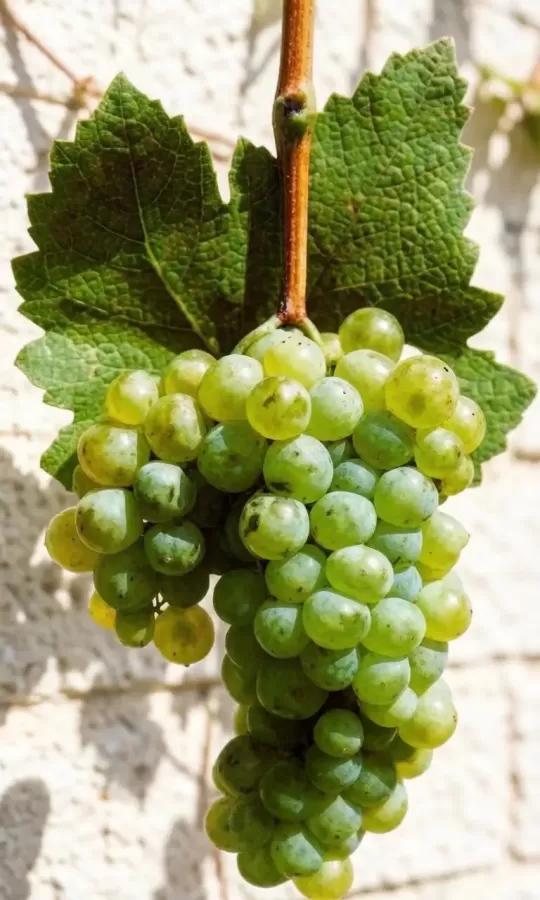
- Cluster: Medium-sized (14.4 cm long and 7.9 cm wide), cylindrical (resembling a corn cob), very dense, with cluster weight varying widely from 183 to 500 g.
- Berry: Medium-sized (14.6 × 13.6 mm), oval, strongly deformed due to cluster compactness, weighing 1.8 to 2.2 g. The skin is thick, elastic, and greenish-yellow. The pulp is slightly fleshy with a harmonious, pleasantly sweet flavor.
Viticultural Features
Vines of the Keratsuda grape cultivar exhibit medium vigor, high fruitfulness, and high yield. The cultivar is not prone to flower coulure or millerandage (shot berries).
The cultivar is susceptible to downy mildew, powdery mildew, and low winter temperatures, though it shows moderate resistance to grey mold (Botrytis). Moser and Umbrella training systems are most suitable for the Keratsuda cultivar, with Chasselas × Berlandieri 41B and Berlandieri × Riparia Kober 5BB recommended as rootstocks.
Winemaking and Product Characteristics
Based on cluster mechanical composition, Keratsuda is a typical wine grape cultivar. Despite adequate sugar accumulation (19–20%), its low titratable acidity (5–6 g/dm³) limits its enological potential: the grapes are suitable primarily for producing ordinary dry white wines. Overall, the Keratsuda grape cultivar holds limited commercial significance.