Hamburg Muscat
| Variety Passport | |
| Country of origin: | England |
| Variety number VIVC: | 8226 |
| Prime name: | Muscat Hamburg |
| Principal Synonyms: | Muscat de Hamburg, Muscat Black Alexandrian, Tămâioasă Neagră Hamburg, Hamburgski Misket |
| Pedigree given by breeder: | Frankenthal × Muscat of Alexandria |
| Pedigree confirmed by markers: | Schiava Grossa x Muscat of Alexandria |
| Species: | Vitis vinifera |
| Ripening period: | Medium-late |
| Classification and Use: | Table, Fresh consumption, Long-term storage |
| Resistance group: | Susceptible |
| Data Sources: | Vitis International Variety Catalogue (VIVC), Сорта винограда (Е. Н. Докучаева изд. 1986) |


| Agrobiology | |
| Vigor: | Semi-vigorous |
| Flower type: | Hermaphrodite |
| Downy mildew susceptibility: | 5 points (high susceptibility) |
| Powdery mildew susceptibility: | 5 points (high susceptibility) |
| Botrytis susceptibility: | 5 points (high susceptibility) |
| Winter hardiness: | Non-hardy (-15...-17°C) |
| Fertility coefficient: | 1,06 |
| Bud fertility index: | 1,58 |
| Percentage of fruitful shoots: | 67% |
| Pruning length: | Short, 2-4 buds |
| Recommended rootstocks: | RR 101-14, SO 4, 41 B |
| Clusters and berries | |
| Bunch shape: | Conical |
| Bunch density: | Loose |
| Average bunch weight: | 168-267 g |
| Berry shape: | Oval |
| Berry skin color: | Black |
| Average berry weight: | 3,1-4,15 g |
| Seed development: | Seeded |
| Flesh texture: | Juicy, Fleshy |
| Berry skin thickness: | Medium |
| Berry skin texture: | Medium |
| Sugar content: | 16-22% |
| Total acidity: | 6-8 g/l |
| Berry Flesh Color: | Non-colored |
| Juice yield: | 74% |
| Flavor type: | Muscat |
| Ampelographic overview |
General Characteristics
The grape variety Hamburg Muscat was bred in England specifically for greenhouse cultivation by crossing the Frankenthal and Muscat of Alexandria varieties. The variety became widely distributed in France, Hungary, Romania, Greece, and Tunisia, and is also found in the USA, Argentina, and other countries. Within the Ukrainian SSR, the grape variety Hamburg Muscat was officially released in the Vinnitsa, Zakarpatye, Zaporozhye, Crimea, Nikolaev, Odessa, and Kherson regions.
The vegetative period from bud burst to harvest maturity in Odessa lasts an average of 148 days with a sum of active temperatures of 2870 °C. The grape variety Hamburg Muscat belongs to the group of medium-late ripening varieties, with berry maturity occurring in the second half of September. The vines are characterized by medium vigor; however, when grown on deep, fertile soils, the growth vigor is rated as above medium. The wood maturity of one-year-old shoots is satisfactory, but under conditions of excessive moisture and insufficient heat, the canes mature poorly. The shoots are distinguished by dense foliage.
The variety has a potentially high but insufficiently stable yield performance. According to data from the Voznesensk state variety testing plot in the Nikolaev region, the average long-term yield under non-irrigated conditions was 137.2 centners per hectare (with a maximum of up to 214.7 centners per hectare). In Odessa, the yield varies from 35.6 to 113.6 centners per hectare. With a potential yield performance of 133 centners per hectare, the calculated net income reaches high values with a profitability level of 391.6%. Fresh grapes have the highest sensory tasting score of 9 points. The sugar content levels reach 16–22 g/100 ml with a titratable acidity of the juice of 6–8 g/l.
Morphological Description of the Grape Variety Hamburg Muscat
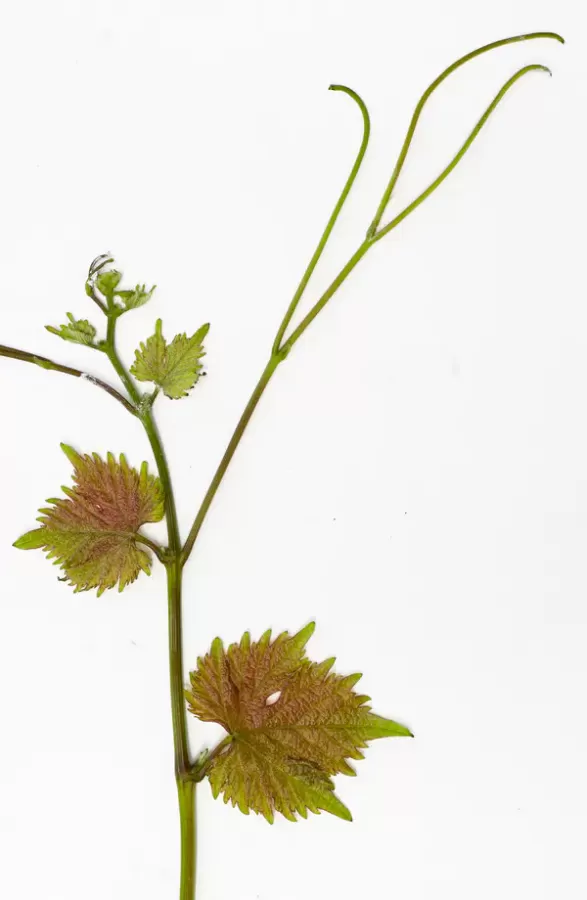
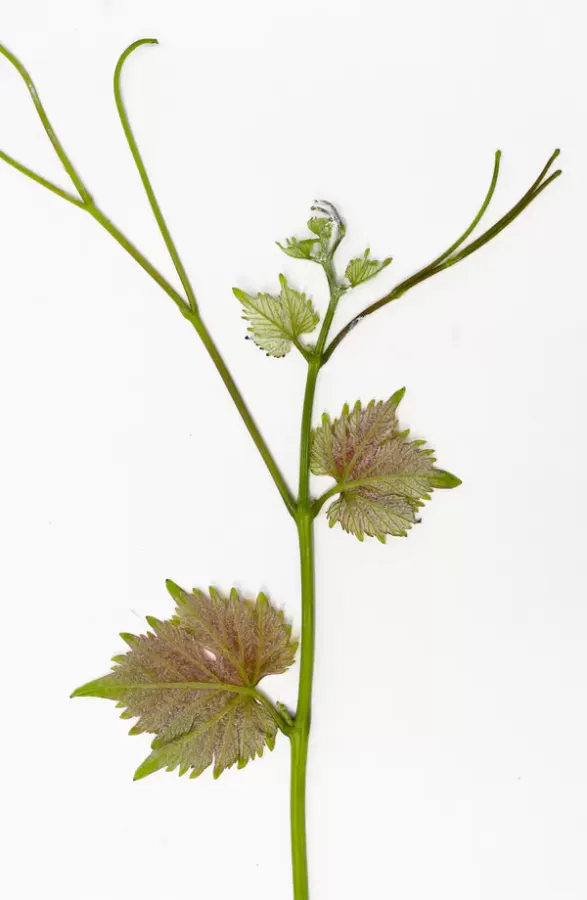
- Young shoot (shoot tip): The shoot tip of the young shoot is pinkish-white, covered with dense felt-like pubescence, and the teeth are wine-red. Young leaves are covered with araneose (cobwebby) pubescence on the upper side and dense felt-like pubescence on the lower side; the blade color is green with bronze spots and wine-red margins along the teeth.
- One-year-old mature cane: The mature dormant cane has a brown color with reddish nodes. Saplings are characterized by semi-prostrate shoots.
- Leaf: Leaves are of medium size to large, cordate, five-lobed, medium- and deeply cleft, and wavy with crinkled (gofred) margins. In saplings, the leaves are weakly funnel-shaped-guttered with finely crinkled margins and an elongated central lobe. The upper lateral sinuses are of medium depth, closed (with a narrow elliptical or oval opening), sometimes open and lyre-shaped with parallel sides. The lower sinuses are small, open, and slot-like or in the form of an incoming angle. The petiolar sinus is closed with an elliptical opening or open and lyre-shaped. The teeth at the tips of the lobes are elongated, sharp, and triangular. The marginal teeth are triangular, one-sidedly convex, and sharp. Pubescence on the lower surface of the leaf is sparse and araneose, and bristly along the veins. The autumn leaf coloration is yellow.
- Flower: The flower type is hermaphroditic (perfect), and the variety is homozygous for flower sex.
- Bunch: Bunches are of medium size or large (18–20 cm long, 11–17 cm wide), conical, branched, sometimes winged, and loose in structure. The herbaceous-green peduncle of the bunch has a medium length of 4–6 cm. The average bunch weight is 168–267 g.
- Berry: Berries are predominantly large (12–26 mm long, 11–12 mm wide), varying in size, and circular or oval in shape. The skin color is violet-blue, covered with a thick waxy bloom (pruina). The skin is relatively firm. The flesh texture is firm and juicy (fleshy-juicy), and the flavor is very pleasant with a delicate, original muscat aroma. The average weight of 100 berries is 310–415 g. The berry contains 2–3 large seeds. The variety is prone to flower dropping and the formation of a significant amount of seedless shot berries (millerandage) in unfavorable years.
Viticultural and Agrotechnical Features
The percentage of fertile shoots for the grape variety Hamburg Muscat is 67%. The average number of inflorescences per developed shoot is 1.06, and 1.58 per fertile shoot. The variety grows and fruits well on southern and southwestern slopes with light loamy, sandy loam, and sandy soils. Recommended rootstocks include Riparia × Rupestris 101-14, Berlandieri × Riparia SO4, and on calcareous soils, Chasselas × Berlandieri 41B.
The grape variety Hamburg Muscat is characterized by low frost resistance and belongs to the group of weakly frost-resistant varieties. Damage to more than 50% of the technological buds occurs when the temperature drops to minus 18–19 °C. Due to its weak frost resistance under covered viticulture, the most suitable vine training system is the double Guyot with a pruning length of 4–6 buds, with a total vine load of 18–20 shoots (of which 11–13 are fertile). In the warmest regions (south of the minus 19 °C isotherm) on slopes, it is possible to apply a high-trunk double cordon training system with a trunk height of 1.2 m and short pruning of shoots, taking into account bud survival.
The grape variety Hamburg Muscat is genetically susceptible to downy mildew (Plasmopara viticola), powdery mildew / oidium (Uncinula necator), gray mold / botrytis rot of berries, bacterial canker, and root phylloxera, but is less damaged by the European grapevine moth (Lobesia botrana) than other varieties. According to its mechanical composition, it belongs to typical table grape varieties. Bunch composition parameters: juice — 74%, stems — 4.4%, skin and firm parts of the flesh — 19.3%, and seeds — 2.3%. Physical parameters: the average force required for berry detachment is 290 g, and the berry crushing resistance is 1265 g. The grapes tolerate transportation well and can be stored for 2–3 months. Products made from the berries of this variety (compotes, juices, jams, marinades) are distinguished by very high flavor qualities.