Reliance
| Variety Passport | |
| Country of origin: | USA |
| Breeder: | University of Arkansas, James N. Moore |
| Variety number VIVC: | 10009 |
| Prime name: | Reliance |
| Breeding number: | Ark. 1163 |
| Patent: | US Plant 5,174 |
| Principal Synonyms: | Reliance Seedless, Arkansas 1163 |
| Year of obtaining / registration: | Cross made in 1964, seedling selected in 1967, US Plant Patent granted in 1984. |
| Pedigree given by breeder: | Ontario × Suffolk Red |
| Pedigree confirmed by markers: | Ontario × Suffolk Red |
| Species: | Interspecific hybrid |
| Ripening period: | Early |
| Classification and Use: | Table, Seedless, Fresh consumption, Long-term storage, Raisin production |
| Resistance group: | Complex resistant |
| Data Sources: | Vitis International Variety Catalogue (VIVC), Google Patents |


| Agrobiology | |
| Vigor: | Vigorous |
| Lateral shoot formation: | Weak |
| Flower type: | Hermaphrodite |
| Downy mildew susceptibility: | 2 points (resistant) |
| Powdery mildew susceptibility: | 2 points (resistant) |
| Winter hardiness: | Very high frost resistance (below -27°C) |
| USDA Hardiness Zone: | Zone 4 (down to -34.4°C) |
| Rooting ability: | High |
| Bud fertility index: | 2 |
| Clusters and berries | |
| Bunch shape: | Cylindro-conical |
| Bunch density: | Medium |
| Average bunch weight: | 300 g |
| Berry shape: | Rounded |
| Berry skin color: | Pink |
| Average berry weight: | 2,7 g |
| Seed development: | Rudimentary seeds |
| Seedlessness class: | I (rudiments up to 6 mg) |
| Flesh texture: | Melting |
| Berry skin texture: | Tender |
| Sugar content: | 17,8-27% |
| Total acidity: | 7,5 g/l |
| Flavor type: | Labrusca |
| Ampelographic overview |
Main Characteristics
The Reliance grape variety (selection number Ark. 1163) was bred by James N. Moore at the Arkansas Agricultural Experiment Station (University of Arkansas, Clarksville, USA) from a controlled cross of Ontario and Suffolk Red made in 1964. Seeds were germinated in a greenhouse during the winter of 1964–1965, seedlings were planted in the field in the spring of 1965, and initial fruiting and selection of the elite form occurred during the summer of 1967. U.S. Plant Patent 5,174 for the Reliance variety was granted on January 10, 1984.
Reliance is a seedless table grape variety of an early ripening period intended for fresh consumption and raisin production. Fruit ripens early, about with the Fredonia cultivar: on average July 25 in central Arkansas, August 24 at Wooster, Ohio, and September 10 at Sturgeon Bay, Wisconsin. Good color development does not occur until full maturity, though berries are sweet and well-flavored at the color inception stage. Average cluster weight is 297–300 g (averaging 108 berries per cluster), and average berry weight is 2.7 g. Soluble solids reach 23.7% in Arkansas, 27% in Texas, and 17.8% in Ohio, with total acids at 0.75% (in Ohio). The berry flavor is very sweet, combining high soluble solids with a distinct, delicate labrusca aroma and flavor rated as unique and outstanding. In cold storage tests, Reliance grapes kept well for about three months.
Morphological Description of the Reliance Grape Variety
The distinguishing characteristics of the Reliance grape variety are early-maturing seedless pink berries with outstanding flavor, high sugar content, and exceptional cold hardiness. Descriptions of vegetative and reproductive organs are based on specimens grown at Clarksville, Arkansas, using the Royal Horticultural Society Colour Chart (RHS, 1966):
- Vine and canes: Vines are medium in size and vigorous (characterized in the summary as vigorous and typically labrusca in character, and in the detailed description as having medium vigor). Mature canes are of medium diameter (9 mm at the base, 6 mm at the midpoint, 2 mm at the terminal), long, with little branching, and not upright in growth habit. Internode length is 4.6 cm at the base, 9.5 cm at the midpoint, and 6.3 cm at the terminal. Color of mature cane is greyed-orange (165-B at the base, 175-B at the midpoint, 166-B at the terminal).
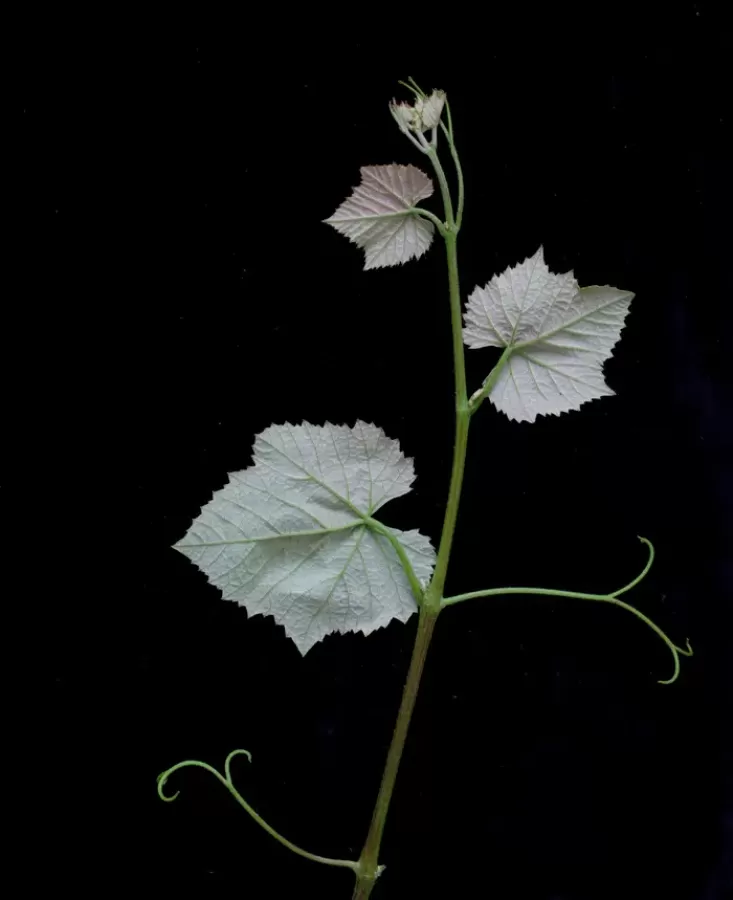
- Leaf: Older leaves near the base of shoots are dark green (Green Group 137B) on the upper surface and greyed-green (194B) on the lower surface. Young leaves near the shoot tip are yellow-green (144B) on the upper surface and greyed-green (196C) on the lower surface. Petioles of both mature and young leaves are yellow-green (144B). The lateral sinus of a mature leaf at the base of the cane is 4.75 cm deep, 5.3 cm wide at the widest point, and 1.2 cm wide at the midpoint.
- Flower: Hermaphroditic (bisexual), blossom color yellow-green (144C). Stamens are medium and erect; pistils are medium-long; pollen is normal. At Clarksville, the average date of first bloom is May 11, and last bloom is May 20.
- Cluster: Medium-large (11–20 cm long, averaging 14 cm; 10–14 cm wide, averaging 11 cm; average weight 297–300 g), cylindrical or conical, tapering, occasionally with a shoulder, well-filled but not excessively compact.
- Berry: Medium-sized (average weight 2.7 g), uniform, round (spherical), pink at maturity (greyed-red 182B with bloom and greyed-purple 183C without bloom). The skin is very tender and non-adhering to the flesh; the flesh has a melting texture. Seedlessness is of the stenospermocarpic type, containing very small, non-lignified vestigial seed traces that are unnoticeable when eaten.
Agrotechnical Features and Resistance
The Reliance grape variety exhibits wide climatic and soil adaptability, performing well from the warm climate of southwest Texas to the cold winter regions of Wisconsin and Ohio. Vines demonstrate outstanding winter hardiness: at Sturgeon Bay, Wisconsin, plants survived and fruited for eight consecutive years during which midwinter temperatures reached minus 34 °C, and also showed above-average cold hardiness in Ohio trials.
Productivity is medium and consistent (averaging 48 clusters per vine in Ohio, usually with two clusters per shoot). Vines are moderately resistant to black rot (Guignardia bidwelli), anthracnose (Elsinoe ampelina), powdery mildew (Uncinula necator), and downy mildew (Plasmopara viticola); a spray program sufficient for the Concord variety controls these diseases on Reliance. In Arkansas and North Carolina, berries showed a tendency to crack in some years following rains during the final maturation period, though this condition was not observed in Ohio, Wisconsin, or Texas.
The Reliance grape variety propagates readily by rooting both hardwood and softwood cuttings and by grafting onto rootstocks with no graft incompatibility observed. Vines produce well as own-rooted plants in all tested locations except on the high-pH, calcareous soils of southwest Texas, where grafting is required.