Saturn
| Variety Passport | |
| Country of origin: | USA |
| Breeder: | University of Arkansas, James N. Moore |
| Variety number VIVC: | 15363 |
| Prime name: | Saturn |
| Breeding number: | Ark. 1448 |
| Patent: | US Plant Patent 6,703 |
| Year of obtaining / registration: | crossed in 1971, seedling selected in 1974, U.S. patent issued on March 28, 1989 (filed November 13, 1987) |
| Pedigree given by breeder: | Dunstan 210 × New York 45791 |
| Species: | Interspecific hybrid |
| Ripening period: | Mid-season |
| Classification and Use: | Dual-purpose, Fresh consumption, Dry Table Wines, Long-term storage |
| Resistance group: | Moderately resistant |
| Data Sources: | Vitis International Variety Catalogue (VIVC), Google Patents |


| Agrobiology | |
| Vigor: | Semi-vigorous |
| Flower type: | Hermaphrodite |
| Downy mildew susceptibility: | 4 points (susceptible) |
| Powdery mildew susceptibility: | 3 points (tolerant) |
| Winter hardiness: | Medium frost resistante (-21...-23°C) |
| USDA Hardiness Zone: | Zone 6 (down to -23.3°C) |
| Rooting ability: | High |
| Fertility coefficient: | 2 |
| Clusters and berries | |
| Bunch shape: | Conical, Winged |
| Bunch density: | Dense |
| Average bunch weight: | 236 g |
| Berry shape: | Oval |
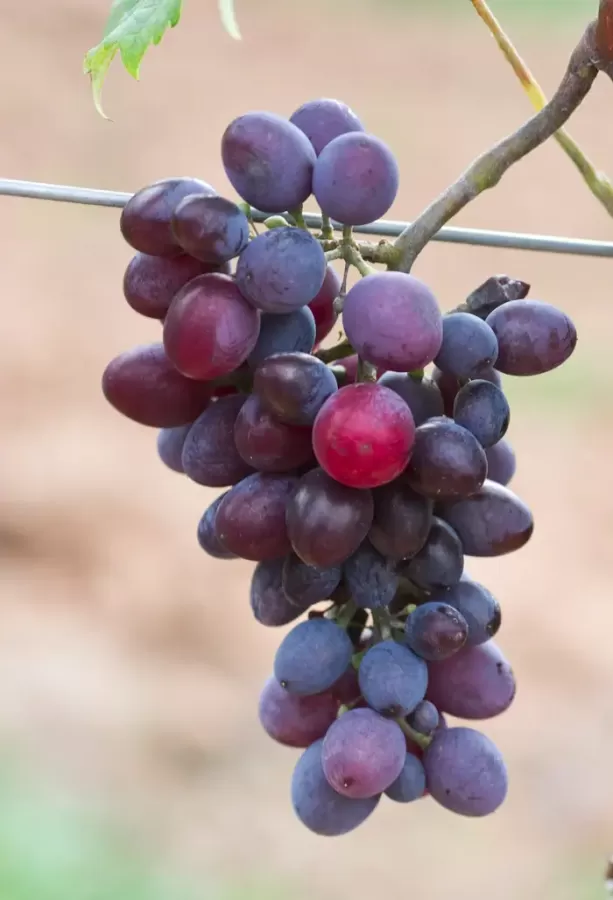
| Berry skin color: | Red |
| Average berry weight: | 3 g |
| Seed development: | Rudimentary seeds |
| Flesh texture: | Firm / Crunchy |
| Berry skin thickness: | Thin |
| Sugar content: | 20% |
| Total acidity: | 5,1 g/l |
| Flavor type: | Neutral |
| Ampelographic overview |
Main Characteristics
The grape variety Saturn was bred in the USA at the University of Arkansas by James N. Moore from a controlled cross between Dunstan 210 and New York 45791, made in 1971 at the experimental vineyard in Clarksville, Arkansas. Seeds were germinated in a greenhouse during the winter of 1971–1972, seedlings were planted in the field in the spring of 1972, and first fruiting occurred in the summer of 1974, when the promising selection was designated Ark. 1448. U.S. Plant Patent 6,703 was granted on March 28, 1989.
The Saturn variety is a midseason ripening seedless grape of the stenospermocarpic type. In central Arkansas, the fruit ripens on average by July 30—approximately 2 weeks after the Venus cultivar and 1 week after Reliance. Soluble solids content reaches 20% with a total acidity of 0.51% (5.1 g/L) and a pH of 3.55. The berry flavor is pleasingly sweet and typically Vitis vinifera in character, with no strong flavor components. In addition to fresh consumption, the grape variety Saturn can be processed into acceptable blending wines of Vitis vinifera character.
Morphological Description of the Grape Variety Saturn
Distinctive features of the Saturn variety include its attractive bright red color, oval berry shape, very firm crisp flesh, and long-term storage capability. Detailed ampelographic characteristics (based on specimens grown at Clarksville and The Royal Horticultural Society Colour Chart) include the following traits:
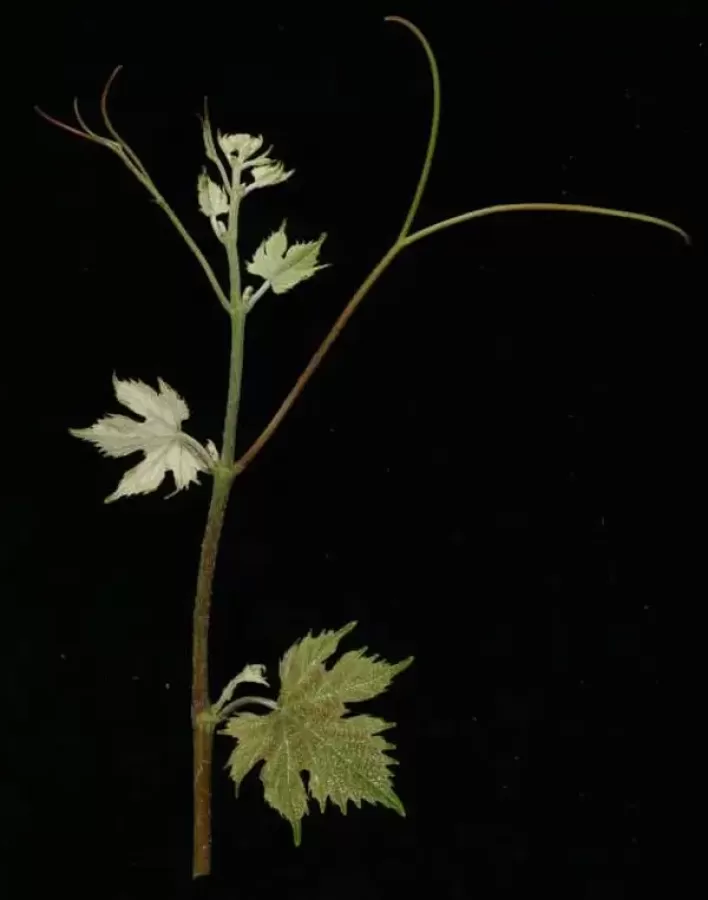
- Vine and canes: vines are medium-sized, with medium to vigorous growth that ceases in early fall. Budbreak occurs around March 25. Mature one-year-old canes are of medium diameter (10.0 mm at the base, 6.0 mm at the midpoint, 2.0 mm at the terminal), long, semi-upright in growth habit, and greyed-orange in color (166B at the base, 165B at the midpoint and terminal). Internode length is 3.0 cm at the base, 9.0 cm at the midpoint, and 4.5 cm at the terminal. Growing shoots in spring are yellow-green (146C at the base, 144A at the terminal).
- Mature leaf: mature leaves near the base of the shoot and sub-terminal fully expanded leaves are yellow-green (147A) on the adaxial surface and green (139C) on the abaxial surface; mature leaves have no pubescence. Petioles are yellow-green (146D) on young leaves and greyed-purple (183C) on mature leaves. The petiolar sinus of a mature leaf at the base of the cane is 4.0 cm deep and 4.0 cm wide at the widest point.
- Flower: hermaphroditic; stamens are medium and erect, pistils are medium long, and pollen is normal. Blossom color is yellow-white (158D). Bloom occurs from June 2 to June 10.
- Cluster: medium-sized (length 12–18 cm, average 13.4 cm; width 10–15 cm, average 10.7 cm), average weight 236 g, with an average of 95 berries per cluster. Cluster shape is short-conic with a slight taper, occasionally with a shoulder; compact and well-filled. Peduncles are short, and clusters form close to the supporting shoots.
- Berry: medium-large for a seedless grape, uniform in size, average weight 3.0 g (length 2.1 cm, diameter 0.9 cm at the base, 1.7 cm at the equator, 0.7 cm at the apex), oval in shape. Color at maturity is bright red (Greyed-purple Group 187A). The skin is thin and adheres to the flesh. The flesh texture is very firm and crisp. Berries contain very small, soft, non-lignified vestigial seed traces that are unnoticeable when eaten.
Agrotechnical Features and Storage
The grape variety Saturn demonstrates wide adaptability to differing soil and climatic conditions. Vines are precocious in bearing and produce good crops early after planting: mature vines average 56 clusters per vine (usually 2 clusters per shoot), with productivity reaching 13–16 MT/ha. Due to precocity, young vines may overproduce, resulting in uneven ripening within clusters, and benefit from cluster thinning. The variety roots readily from both hardwood and softwood cuttings and grafts onto rootstocks with no observed graft incompatibility. It produces well as an own-rooted plant in most tested locations, except on the calcareous soils of southwest Texas, where grafting onto a rootstock is required.
Cold hardiness of the Saturn variety is average for seedless grapes: vines are hardy to −23 °C, though wood injury may occur at lower temperatures. The variety is moderately tolerant of black rot (Guignardia bidwelli), anthracnose (Elsinoe ampelina), and powdery mildew (Uncinula necator), but is susceptible to downy mildew (Plasmopara viticola), requiring a spray program for disease control in humid areas.
Ripe fruit maintains its quality well on the vine after maturity: berries adhere well to the pedicels, do not shatter, and show no inclination to split following rains. Fresh fruit of the Saturn variety exhibits exceptional storage quality—clusters store well for up to 12 weeks at 2 °C under SO2 pads, far superior in storage capability to the Venus, Reliance, and Mars cultivars.