Shabash
| Variety Passport | |
| Country of origin: | USSR |
| Variety number VIVC: | 11684 |
| Prime name: | Shabash |
| Principal Synonyms: | Shabash Krupnoyagodnyi |
| Species: | Vitis vinifera |
| Ripening period: | Very late |
| Classification and Use: | Table, Fresh consumption, Long-term storage |
| Resistance group: | Susceptible |
| Data Sources: | Vitis International Variety Catalogue (VIVC), Сорта винограда (Е. Н. Докучаева изд. 1986) |


| Agrobiology | |
| Vigor: | Vigorous |
| Flower type: | Hermaphrodite |
| Downy mildew susceptibility: | 3 points (tolerant) |
| Powdery mildew susceptibility: | 4 points (susceptible) |
| Botrytis susceptibility: | 3 points (tolerant) |
| Root phylloxera susceptibility: | 4 points (susceptible) |
| Winter hardiness: | Low frost resistance (-18...-20°C) |
| Fertility coefficient: | 0,5-0,8 |
| Bud fertility index: | 1,3 |
| Percentage of fruitful shoots: | 60% |
| Pruning length: | Medium, 5-8 buds |
| Clusters and berries | |
| Bunch shape: | Cylindro-conical |
| Bunch density: | Loose, Medium |
| Average bunch weight: | 160-210 g |
| Berry shape: | Oval |
| Berry skin color: | White |
| Average berry weight: | 3,2-3,5 g |
| Seed development: | Seeded |
| Flesh texture: | Fleshy, Firm / Crunchy |
| Berry skin thickness: | Very thick |
| Berry skin texture: | Tough |
| Sugar content: | 14-19% |
| Total acidity: | 7,5-10 g/l |
| Juice yield: | 74,2% |
| Flavor type: | Neutral |
| Ampelographic overview |
Main Characteristics
The grape variety Shabash is a local Crimean variety that concludes the harvest of all grape varieties in Crimea (Shabash translates from Turkic as "end"). Based on morphological traits and biological properties, it belongs to the group of Eastern table-wine varieties, while according to the mechanical composition of the cluster, the Shabash variety is classified as a table grape. It is widespread and released on the Southern Coast of Crimea, mainly in the Alushta and Sudak valleys—in zones with the most favorable temperature conditions.
Shabash belongs to varieties of a very late ripening period: 169 days pass from bud burst to harvest maturity at a sum of active temperatures of 3023 °C. Berry ripening occurs in the middle or at the end of the second decade of October. In certain years, in the steppe regions of Crimea and the Kherson Oblast, the crop does not have time to ripen completely. The average cluster weight is 160–210 g, and the average weight of 100 berries is 320–350 g. Cluster composition in percentage: juice — 74.2%, stems — 2.4%, skin, dense parts of the pulp, and seeds — 2.8%. In Crimea, berry sugar content reaches 14–19 g/100 ml with titratable acidity of 7.5–10 g/l. The Shabash grape variety is distinguished by large clusters and berries that withstand long-distance transportation even after prolonged storage: clusters grown in the southern coastal areas of Crimea can be stored in a refrigerator until July. The variety is also suitable for making jams and marinades.
Morphological Description of the Grape Variety Shabash
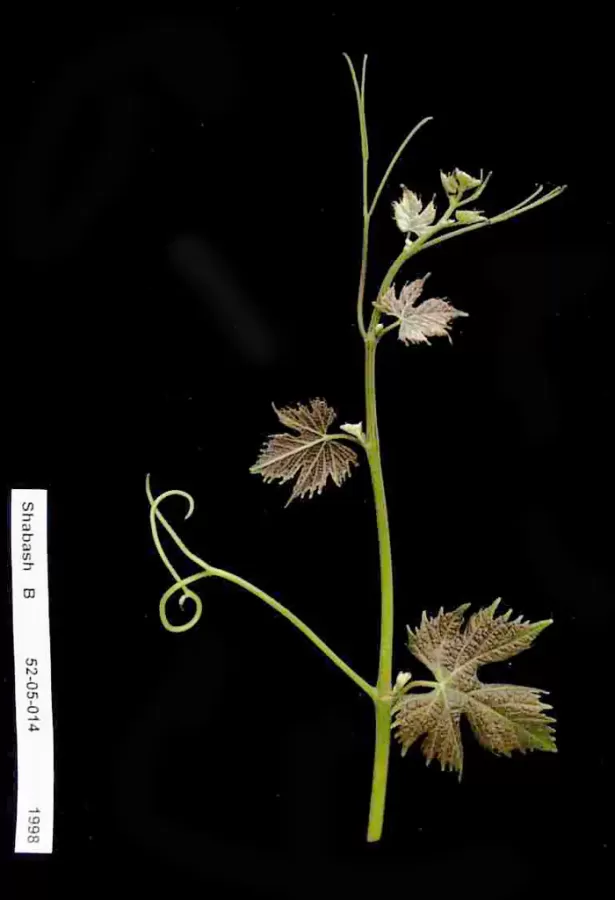
- Young shoot (shoot tip): The shoot tip and first young leaves of the young shoot are light green with a pink rim. Pubescence is weak and cobwebby. Secondary coloration is light bronze.
- One-year-old mature cane: Light brown, with weakly pronounced nodes.
- Mature leaf: Medium-sized or large, round or ovate, 3- or 5-lobed, moderately dissected, finely blistered. Upper lateral sinuses vary from shallow to deep, open lyre-shaped and closed with an elliptical lumen; lower sinuses are shallow, open, vaulted, and lyre-shaped. The petiolar sinus is mostly closed, with an oval lumen. Terminal teeth are wide, triangular, and acute. Marginal teeth are saw-like and acute. Pubescence on the lower leaf surface is barely noticeable, sparse, and bristly. Autumn leaf coloration is yellow.
- Flower: Hermaphrodite (bisexual).
- Cluster: Medium-sized and large (16–20 cm long, 10–12 cm wide), cylindrical-conical, sometimes lobed, loose and medium-dense. The peduncle is of medium length and green.
- Berry: Large (24 mm long, 18 mm wide), oval and elongated-oval, light green and greenish-yellow, with brown sunburn spots on the sunny side. The skin is very thick, tough, and slightly astringent. The pulp is moderately firm and slightly crisp. The taste is simple. Each berry contains 3–4 large seeds.
- Saplings: Semi-spreading. Leaves are three-lobed, with an elongated central lobe, glabrous; the petiolar sinus is lancet-shaped.
The leading distinguishing features of the Shabash variety include tough, almost glabrous, moderately dissected leaves, fairly large clusters, as well as large, oval berries of yellowish-green color with a coarse, slightly astringent skin.
Agrotechnical Features and Resistance
Vines are vigorous, and one-year-old shoots mature well. The Shabash grape variety is characterized by good and high yield depending on climatic conditions and agricultural practices: according to the Genichesk State Variety Testing Plot of the Kherson Oblast, the average yield of the variety over three years (1959–1962) without irrigation was 6.7 t/ha; at the "Koktebel" state farm in the Sudak district of the Crimean Oblast, the average yield reaches 15 t/ha, while in Crimea under irrigation the maximum yield is 20–25 t/ha. Fruit-bearing shoots account for 60% of the vine, with an average of 0.5–0.8 clusters per developed shoot and 1.3 clusters per fruit-bearing shoot.
Shabash grows and fruits well on various soils; however, the best yields and high berry quality are obtained from plantings on warm slopes and light fertile soils. The best vine training system for this variety is a high-trunk bilateral cordon with 14–15 fruiting shoots. The length of fruiting canes should not exceed 6–8 buds, and overloading the vines with crop is unacceptable. The variety is susceptible to powdery mildew and crown gall, less affected by downy mildew and grey rot compared to other varieties, and is damaged by the grapevine moth and phylloxera. Resistance to winter frosts and late spring frosts is low: at minus 19–20 °C, up to 50% of buds are damaged. In years with unfavorable weather conditions, Shabash is prone to flower and ovary shedding (coulure) and berry shot (millerandage). The potential yield of the variety is 15 t/ha.