Shine Muscat
| Variety Passport | |
| Country of origin: | Japan |
| Breeder: | NARO (Japan) |
| Variety number VIVC: | 22688 |
| Prime name: | Shine Muscat |
| Patent: | № 13891 MAFF, Japan |
| Principal Synonyms: | Yangguang Meigui, Akitsu 23, Sunshine Rose |
| Year of obtaining / registration: | breeding 1988, application filed on August 11, 2003; variety entered into the national register on March 9, 2006 |
| Pedigree given by breeder: | Akitsu-21 × Hakunan |
| Species: | Interspecific hybrid |
| Ripening period: | Early-medium |
| Classification and Use: | Table, Commercial sale, Fresh consumption |
| Resistance group: | Moderately resistant |
| Data Sources: | Vitis International Variety Catalogue (VIVC), NARO Repository (National Agriculture and Food Research Organization, Japan), MAFF Plant Variety Protection Database (Japan), Henan Academy of Agricultural Sciences (HAAS, China) |


| Agrobiology | |
| Vigor: | Vigorous |
| Flower type: | Hermaphrodite |
| Downy mildew susceptibility: | 3 points (tolerant) |
| Powdery mildew susceptibility: | 3 points (tolerant) |
| Botrytis susceptibility: | 3 points (tolerant) |
| Winter hardiness: | Low frost resistance (-18...-20°C) |
| Bud fertility index: | 1,5 |
| Pruning length: | Short, 2-4 buds |
| Clusters and berries | |
| Bunch shape: | Cylindro-conical, Winged, Branched |
| Bunch density: | Medium |
| Average bunch weight: | 600-800 g |
| Berry shape: | Oval |
| Berry skin color: | White |
| Average berry weight: | 6-8 g |
| Seed development: | Seeded |
| Flesh texture: | Fleshy, Firm / Crunchy |
| Berry skin texture: | Medium |
| Sugar content: | 18-22% |
| Berry Flesh Color: | Non-colored |
| Flavor type: | Muscat |
| Ampelographic overview |
Main Characteristics
The Shine Muscat grape variety (シャインマスカット, synonym: Yangguang Meigui / 阳光玫瑰) was bred in Japan by the National Agriculture and Food Research Organization (NARO) by crossing Akitsu-21 and Hakunan. The application for variety registration (No. 15936) was filed on August 11, 2003, and the variety was officially entered into the National Register of Varieties of Japan (Registration No. 13891) on March 9, 2006. The duration of breeder's rights is set for 40 years, with restrictions on exporting propagation material outside the country. By species origin, it is an interspecific (Euro-American) hybrid of table direction.
At its place of origin (Akitsu Town, Toyota District, Hiroshima Prefecture, Japan), Shine Muscat is characterized as an early-ripening variety: budbreak occurs at mid-season, flowering is late, and berry maturity is reached in mid-August. When introduced to China (trials in the Zhengzhou area, Henan Province), the variety behaves as later-ripening: budbreak is recorded in early April, flowering in early May, and full maturity is reached in late August.
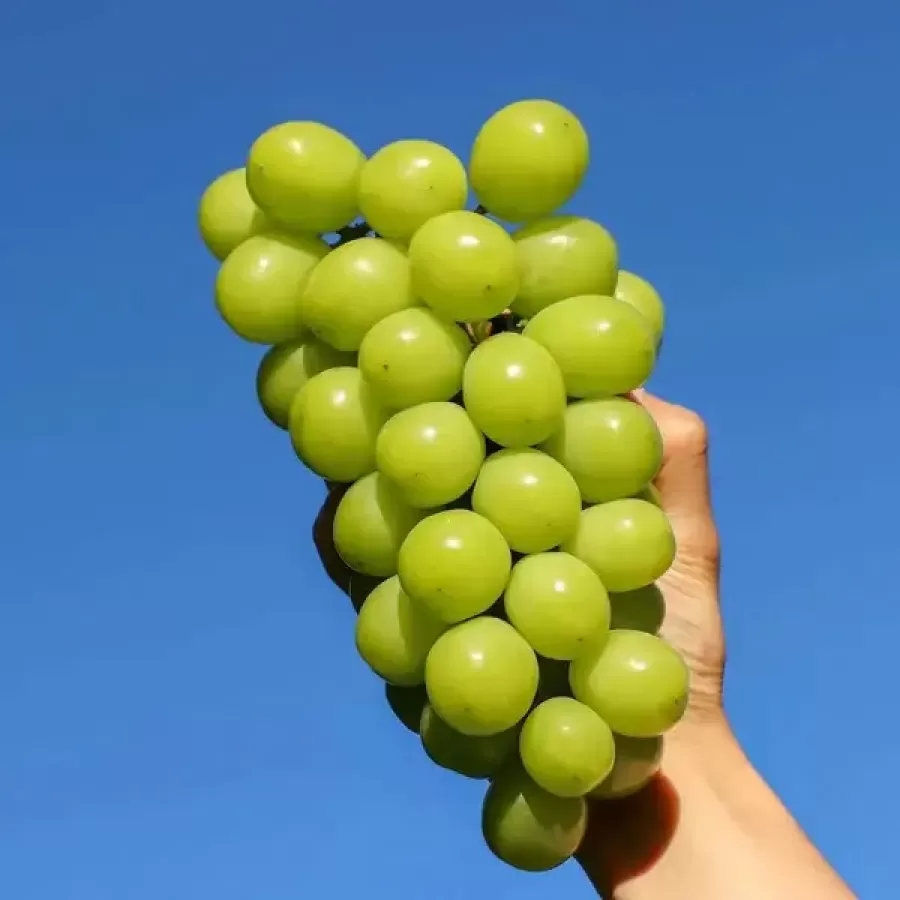
The Shine Muscat grape variety produces very large clusters; under Chinese cultivation conditions, their average weight is 600–800 g, reaching a maximum of 1,500 g. Berries are large and uniform in size, with an average weight of 6–8 g. The skin is yellowish-green or yellowish-white, turning golden-yellow at full maturity, of medium thickness (noted as thin and edible in Chinese trials), with a medium waxy bloom (pruin) and medium separability from the pulp. The pulp is uncolored, firm and crisp, and very juicy. The flavor is distinguished by high sugar accumulation (18–22%, up to a maximum of 27%), low acidity, absent or extremely weak astringency, and a pronounced muscat aroma.
Morphological Description of the Shine Muscat Grape Variety
- Vine and Shoots: Vine vigor is above medium to strong, and the canopy spreads rapidly. The young shoot tip is light red. Tendril distribution is discontinuous (2 consecutive tendrils). Mature canes are thick, yellowish-brown, with a smooth surface and a round internode cross-section.
- Mature Leaf: Leaves are large, pentagonal in shape, and five-lobed. The leaf blade cross-section is trough-shaped (channeled). The upper surface is green. On the lower side, prostrate hairs between the veins and along the main veins are dense. Marginal teeth have both sides straight. Upper lateral sinuses are closed and shallow; the petiole sinus is closed. The petiole is thick, light pink, with dense prostrate pubescence, and shorter than the midrib.
- Flower and Inflorescence: Flowers are hermaphroditic, with abundant pollen. The number of inflorescences per shoot is medium.
- Cluster: Very large, long, branched-cylindrical or conical with a wing, and of medium density. The peduncle is thick, long, and light pink.
- Berry and Pedicel: Berries are large and short-elliptical (oval) in shape. The pedicel is thick, short, and yellowish-green; berry attachment strength is high, with medium separation. Berries contain a medium number of large seeds; the presence of seedless berries is absent or extremely minor.
Agrotechnical Features
The Shine Muscat variety is characterized by high fruit bud differentiation, high budbreak, and a high percentage of fruitful shoots. A fruitful shoot predominantly bears 1 inflorescence, rarely 2 (usually at the 3rd–4th node). Cane maturation is good. Under Chinese conditions, yield in the second year after planting reaches 0.75 kg/m².
Due to strong vine vigor, the variety is recommended to be grown on training systems that facilitate management and allow the installation of rain shelters, such as a high, wide trellis with hanging shoots. Winter pruning is predominantly short combined with medium pruning, leaving a 3–5 cm protective stub above the top bud; the winter pruning load is about 9 buds per 1 m² (leaving about 5.2 shoots per 1 m² after summer shoot thinning, at a fruitful-to-vegetative shoot ratio of 3:1).
Natural berry set in the Shine Muscat grape variety is good (flower and fruitlet drop in Japan is rated as medium). To form marketable clusters before flowering, the wing and 1–2 basal branches are removed, overly long branches are trimmed back, and the cluster tip is pinched by 1–2 cm, followed by berry thinning after fruit set. Ripe clusters can hang on the vine for a long time (up to two months in China, until frost) without losing flavor quality, cracking, shattering, or losing color; however, leaving the crop on the vine for too long can weaken winter hardiness and reduce the following year's yield.
Berry cracking is virtually absent. The variety possesses increased disease resistance, though the berries are susceptible to anthracnose. To protect the crop from diseases, cultivation under plastic rain shelters and mandatory cluster bagging 1–3 days after fungicide treatment are recommended.