Chaouch Blanc
| Variety Passport | |
| Country of origin: | Turkey |
| Variety number VIVC: | 10196 |
| Prime name: | Chaouch Blanc |
| Principal Synonyms: | Chaush, Chaus, Geinovyi |
| Year of obtaining / registration: | released for cultivation in the USSR (Ukrainian SSR) in 1944 |
| Species: | Vitis vinifera |
| Ripening period: | Early |
| Classification and Use: | Table, Fresh consumption, Raisin production |
| Resistance group: | Susceptible |
| Data Sources: | Vitis International Variety Catalogue (VIVC), Сорта винограда (Е. Н. Докучаева изд. 1986) |


| Agrobiology | |
| Vigor: | Very vigorous |
| Flower type: | Female |
| Downy mildew susceptibility: | 5 points (high susceptibility) |
| Powdery mildew susceptibility: | 5 points (high susceptibility) |
| Botrytis susceptibility: | 5 points (high susceptibility) |
| Root phylloxera susceptibility: | 3 points (tolerant) |
| Winter hardiness: | Non-hardy (-15...-17°C) |
| Fertility coefficient: | 0,8 |
| Bud fertility index: | 1,4 |
| Percentage of fruitful shoots: | 54% |
| Pruning length: | Medium, 5-8 buds |
| Recommended rootstocks: | Riparia Gloire de Montpellier, RR 101-14, SO 4 |
| Clusters and berries | |
| Bunch shape: | Cylindro-conical, Branched |
| Average bunch weight: | 240-350 g |
| Berry shape: | Oval, Ovoid |
| Berry skin color: | White |
| Average berry weight: | 4,8-5,3 g |
| Seed development: | Seeded |
| Flesh texture: | Juicy, Fleshy |
| Berry skin thickness: | Thin |
| Berry skin texture: | Tender |
| Sugar content: | 15% |
| Total acidity: | 8,1 g/l |
| Juice yield: | 89,2% |
| Flavor type: | Varietal |
| Ampelographic overview |
General Characteristics
Chaouch Blanc (synonyms: Chaush, Chaus, Geinovyi) is a Turkish table grape variety belonging to the Black Sea basin eco-geographical group. The variety is widely cultivated in Turkey, Bulgaria, Romania, and Greece; in the USSR (Ukrainian SSR), Chaouch Blanc was released for commercial cultivation in 1944 and is included in the standard assortment of the Crimean region.
In terms of ripening time, Chaouch Blanc belongs to the early-ripening varieties. Under the conditions of the Tsyurupinsk State Variety Testing Plot on the Lower Dnieper sands, 131 days pass from bud burst to harvest maturity (1961–1971 average), with the average date of mass harvest falling on August 30. Vine vigor is very high, and one-year-old shoots mature well (90%).
Actual yields in Tsyurupinsk (Kherson region) average 11.24 t/ha (112.4 c/ha), though they fluctuate considerably from year to year: during 1960–1962 in Tsyurupinsk, yields ranged from 3.25 to 14.22 t/ha (32.5–142.2 c/ha); on the Shabo sands in the Odessa region (1951–1963), from 5.4 to 12.9 t/ha (54–129 c/ha); and in Crimea (1974–1978), from 11.0 to 12.0 t/ha (110–120 c/ha). Cluster weight reaches 240–350 g, and the average weight of 100 berries is 480–530 g. Juice sugar content at harvest is 15 g/100 ml with a titratable acidity of 8.1 g/l. The berry flavor is moderately sweet, with a distinctive herbaceous aftertaste; the tasting score of fresh grapes is 7–8 points.
Ampelographic Description of the Chaouch Blanc Grape Variety
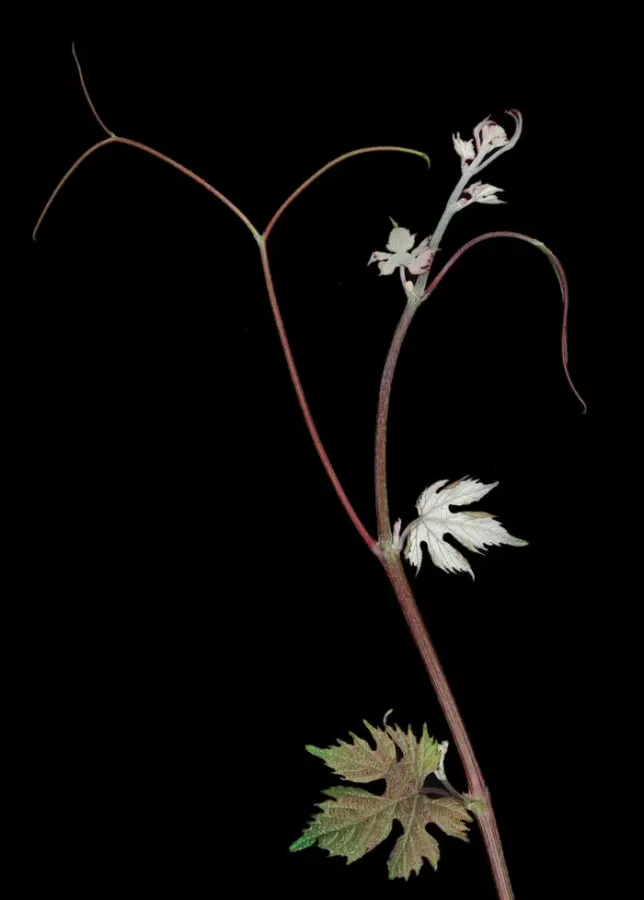
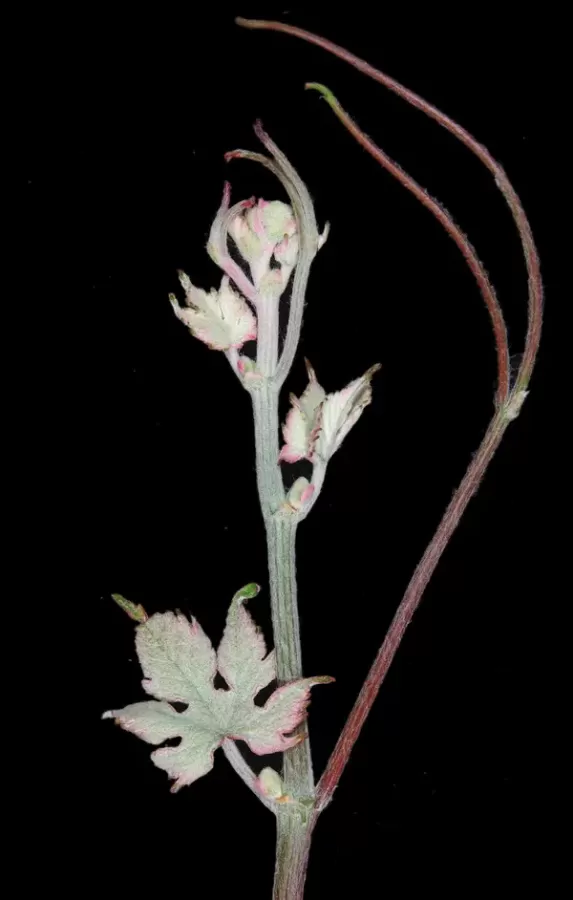
- Young shoot (shoot tip): The shoot tip and first leaves are white from dense felty pubescence, with pink spots and matching pink margins on the teeth.
- Mature one-year-old shoot: Dark brown.
- Mature leaf: Very large, round, deeply lobed, five-lobed, and bullate (blistered). Upper lateral sinuses are very deep, with triangular lumens; lower sinuses are also deep, closed with triangular lumens or open, lyre-shaped, with nearly parallel sides. The petiolar sinus is open and vaulted, or closed and slit-like. Apical teeth on the lobes are large and triangular; marginal teeth are also large and triangular-saw-toothed. The lower leaf surface is covered with dense felty pubescence.
- Flower: Functionally female.
- Cluster: Medium to large (18–23 cm long, 8–15 cm wide), cylindrical-conical or irregular in shape, frequently branched, of varying density. The peduncle is 5–7 cm long.
- Berry: Large (22–25 mm long, 18–22 mm wide), oval or ovate, yellowish-green, with a sunburn blush on the sun-exposed side. The skin is covered with a heavy waxy bloom (pruine), thin, and tearing; the pulp is fleshy-juicy. Each berry contains 2–3 large seeds.
- Nursery plants (saplings): With spreading shoots and shoot tips that are bronze-white from dense felty pubescence. Leaves are large, three-lobed, coarsely bullate, with a pubescent lower surface. Autumn leaf coloration is brownish-yellow.
Viticultural Features and Resistance
In the Chaouch Blanc grape variety, the average percentage of fruitful shoots under Tsyurupinsk conditions is 54%, with 0.8 clusters per developed shoot and 1.4 clusters per fruitful shoot. The variety requires high amounts of heat and sunlight and is sensitive to excess moisture, making heavy chernozem soils unsuitable; vineyards are best established on well-warmed sandy, sandy-loam, and carbonate-gravelly soils.
Due to its functionally female flower type, Chaouch Blanc must be planted alongside pollinator varieties (Chasselas, Cinsaut, etc.) at a ratio of one pollinator row for every two rows of Chaouch Blanc. The variety responds well to wide spacing and large training systems with well-developed perennial wood and a well-illuminated canopy; a head-trained (non-trunk) multi-arm fan system with a large reserve of perennial wood is also suitable. Canes are pruned to 8–10 buds, or 6–8 buds on the Lower Dnieper sands. Recommended rootstocks are Riparia × Rupestris 101-14, Berlandieri × Riparia SO4, and Riparia Gloire.
Chaouch Blanc is severely affected by downy mildew, powdery mildew (oidium), and gray rot (Botrytis), and is more heavily damaged by the European grapevine moth than other varieties; however, it belongs to the group of varieties with relative root resistance to phylloxera and root rot processes. Drought resistance is relatively high, while winter hardiness is low: complete bud winterkill reached 78% in severe winters and 66% in milder winters. In years with unfavorable weather conditions, the variety pollinates poorly, and partial flower shatter (coulure) and shot berries (millerandage) occur almost annually.
Technological and Genotypic Characteristics
Based on the mechanical composition of the cluster, the Chaouch Blanc grape variety is classified as a table variety: juice yield accounts for 89.2%, stems for 2.1%, skins for 7%, and seeds for 1.7%. The average berry detachment force is 235 g, and crushing resistance is 1043 g. The grapes are used for fresh consumption as well as for making raisins and compotes.
The variety produces bud sports with oblong-oval berries and muscat-flavored pulp, the best-known of which is Chaush Rozovyi (or Damasskaya Roza). Chaouch Blanc has been extensively used in breeding programs: large-berried early-ripening varieties bred with its participation in the USSR include Rannii VIRa, Muscat AZOS, Odesskii Rannii, and Chaush Muscatnyi, while Misket Dunavski was bred in Bulgaria. In studies conducted at the V. E. Tairov Ukrainian Research Institute of Viticulture and Winemaking (1976–1980), hybrid progeny of the variety demonstrated good viability and vigorous growth, with Chaouch Blanc acting as a recessive homozygote for flower sex and berry color.