Mars
| Variety Passport | |
| Country of origin: | USA |
| Breeder: | University of Arkansas, James N. Moore |
| Variety number VIVC: | 7432 |
| Prime name: | Mars |
| Breeding number: | Ark. 1508 |
| Patent: | US Plant Patent 5,680 |
| Principal Synonyms: | Arkansas 1508, Mars Seedless |
| Year of obtaining / registration: | cross made in 1972, seedling selected in 1975, U.S. Plant Patent issued on March 4, 1986 |
| Pedigree given by breeder: | Island Belle × Arkansas Selection 1339 |
| Pedigree confirmed by markers: | Island Belle (Fredonia) × Arkansas Selection 1339 |
| Species: | Interspecific hybrid |
| Ripening period: | Early |
| Classification and Use: | Table, Seedless, Fresh consumption, Raisin production |
| Resistance group: | Complex resistant |
| Data Sources: | Vitis International Variety Catalogue (VIVC), Google Patents |


| Agrobiology | |
| Vigor: | Vigorous |
| Flower type: | Hermaphrodite |
| Downy mildew susceptibility: | 1 point (highly resistant) |
| Powdery mildew susceptibility: | 1 point (highly resistant) |
| Winter hardiness: | Very high frost resistance (below -27°C) |
| Rooting ability: | High |
| Clusters and berries | |
| Bunch shape: | Conical, Winged |
| Bunch density: | Dense |
| Average bunch weight: | 220-223 g |
| Berry shape: | Rounded |
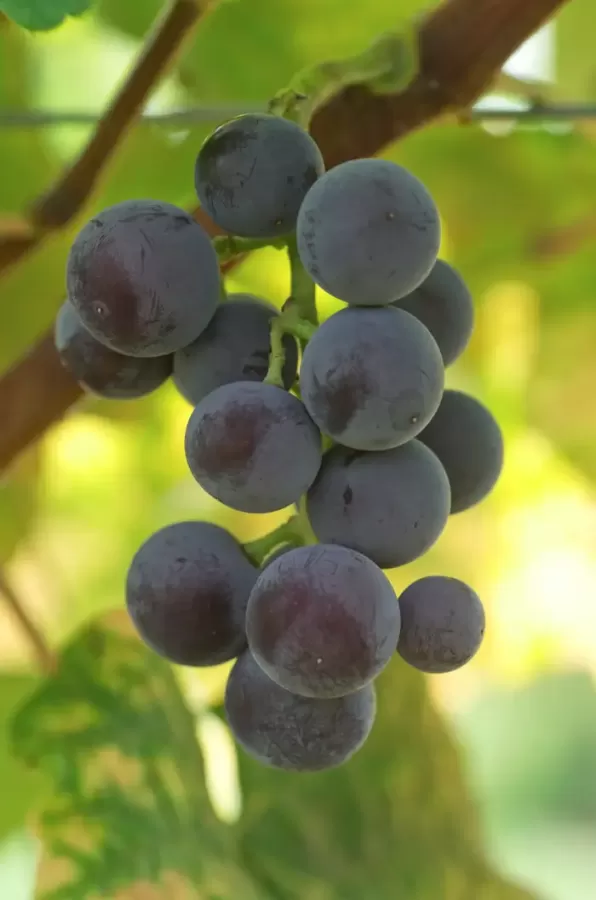
| Berry skin color: | Black |
| Average berry weight: | 3,5 g |
| Seed development: | Seedless |
| Seedlessness class: | I (rudiments up to 6 mg) |
| Flesh texture: | Melting |
| Berry skin thickness: | Medium |
| Sugar content: | 16% |
| Total acidity: | 8,3 g/l |
| Flavor type: | Labrusca |
| Ampelographic overview |
General Characteristics
Mars (breeding number Ark. 1508, U.S. Plant Patent 5,680, issued March 4, 1986) is an early-ripening seedless grape cultivar bred by James N. Moore at the University of Arkansas Agricultural Experiment Station (Fayetteville, Arkansas, USA). The cultivar originated from a controlled, hand-pollinated cross of Island Belle and Arkansas selection 1339 made in 1972 at the experimental vineyard in Clarksville, Arkansas. Seeds were germinated in a greenhouse during the winter of 1972–1973, seedlings were planted in the field in the spring of 1973, and initial fruiting occurred in the summer of 1975, when selection Ark. 1508 was chosen for its outstanding disease resistance, good fruit quality, and seedlessness.
In terms of ripening time, the Mars grape cultivar belongs to the early-ripening cultivars: the fruit ripens approximately 3 days before Fredonia, with an average ripe date of July 22 in central Arkansas. Under Clarksville conditions, first bloom occurs on May 13 and last bloom on May 23. Vines exhibit vigorous growth (described as medium vigor with growth cessation in early fall for specimens grown in Clarksville), typically characteristic of Vitis labrusca; one-year-old canes mature their wood early and enter winter in a well-hardened condition.
Productivity is medium-high (15–18 MT/ha on mature vines), and young vines are precocious in bearing. Average cluster weight is 220–223 g (averaging 64 berries per cluster and 62 clusters per vine). Berries are large for a seedless grape (averaging 3.5 g, larger than Suffolk Red and Canadice), uniform in size, and an attractive blue color at maturity. Soluble solids content is medium (ca. 16%), while total acidity is low (0.83%), giving the fruit a sweet taste. The flavor is strong and typically labrusca in character, resembling Campbell's Early. Fruit quality is maintained well on the vine after maturity, and berries adhere firmly to the pedicels without shattering.
Ampelographic Description of the Mars Grape Cultivar
- Young shoot: Color of the growing shoot in spring is yellow-green (146C according to the Royal Horticultural Society Colour Chart) at the base and yellow-green (144A) at the terminal tip.
- Mature one-year-old shoot: Medium diameter, long, not upright in growth habit. Diameter of the mature cane is 9.5 mm at the base, 6.9 mm at the midpoint, and 2.4 mm at the terminal end; internode length is 2.6 cm, 8.8 cm, and 4.5 cm, respectively. Mature cane coloration is brown (200C) throughout.
- Mature leaf: Older leaves near the base of the shoot are yellow-green (146A) on the upper surface and yellow-green (148C) on the lower surface. Sub-terminal fully expanded leaves are yellow-green (146C) on the upper surface and yellow-green (145C) on the lower surface. Petioles are yellow-green (145C) on both mature and young leaves. The petiolar sinus of a mature leaf at the base of the cane is 4.5 cm deep and 4.8 cm wide at the widest point.
- Flower: Hermaphroditic (bisexual), with yellow-green (144C) blossoms. Stamens are medium-length and erect; pistils are medium-long; pollen is normal.
- Cluster: Medium-sized (11–16 cm long, averaging 13 cm; 9–14 cm wide, averaging 11 cm), short-conic with a slight taper, rarely shouldered, compact, and well-filled. Peduncles are short, and clusters form close to the supporting shoots.
- Berry: Medium-large (averaging 3.5 g), spherical and uniform in shape, blue at maturity (Blue Group 103A). The skin is medium thick and non-adhering to the flesh (slip-skin). The flesh has a melting texture. Seedlessness is of the stenospermocarpic type, containing very small, unlignified vestigial seed traces that are unnoticeable when eaten.
Viticultural Features and Resistance
The Mars grape cultivar demonstrates wide adaptation to differing soil and climatic conditions, confirmed by trials in Arkansas, Texas, New York, Missouri, North Carolina, Minnesota, Indiana, Florida, and South Dakota. Clusters are usually borne two per shoot. Due to their precocity, young vines may overproduce and require cluster thinning. The cultivar produces well as own-rooted plants in all tested locations except on the calcareous soils of southwest Texas, where grafting onto a rootstock is required. Cuttings root readily from both hardwood and softwood, and no graft incompatibility has been observed.
A distinctive feature of the Mars cultivar is its outstanding resistance to common fungal diseases of grapevines: under minimum chemical disease control, the vines and fruit demonstrate high resistance to black rot (Guignardia bidwellii), anthracnose (Elsinoe ampelina), powdery mildew (Uncinula necator), and downy mildew (Plasmopara viticola). The fruit shows no inclination to split following rains. Cold hardiness is above average for a seedless grape, equal to that of the Concord variety.
Uses
The Mars grape cultivar is used for fresh consumption as a table grape and for making raisins. Because of its high resistance to fungal diseases, it is especially suitable for home gardens.