Chasselas Blanc
| Variety Passport | |
| Country of origin: | Egypt |
| Variety number VIVC: | 2473 |
| Prime name: | Chasselas Blanc |
| Principal Synonyms: | Fondant Blanc, Gutedel Weisser, Chasselas Doré, Dinka Belaya, Berezka Prostaya, Zlatina |
| Species: | Vitis vinifera |
| Ripening period: | Early |
| Classification and Use: | Dual-purpose, Fresh consumption, Long-term storage, Juice Production |
| Resistance group: | Susceptible |
| Data Sources: | Vitis International Variety Catalogue (VIVC), Сорта винограда (Е. Н. Докучаева изд. 1986) |


| Agrobiology | |
| Vigor: | Medium |
| Flower type: | Hermaphrodite |
| Downy mildew susceptibility: | 4 points (susceptible) |
| Powdery mildew susceptibility: | 4 points (susceptible) |
| Botrytis susceptibility: | 4 points (susceptible) |
| Root phylloxera susceptibility: | 5 points (high susceptibility) |
| Winter hardiness: | Low frost resistance (-18...-20°C) |
| Fertility coefficient: | 0,9 |
| Bud fertility index: | 1,6 |
| Percentage of fruitful shoots: | 62% |
| Pruning length: | Medium, 5-8 buds |
| Recommended rootstocks: | Riparia Gloire de Montpellier, RR 101-14, Kober 5BB, Teleki 5C, Teleki 8B |
| Clusters and berries | |
| Bunch shape: | Conical, Cylindro-conical |
| Bunch density: | Medium, Dense |
| Average bunch weight: | 193 g |
| Berry shape: | Rounded |
| Berry skin color: | White |
| Average berry weight: | 2,2 g |
| Seed development: | Seeded |
| Flesh texture: | Melting |
| Berry skin thickness: | Thin |
| Berry skin texture: | Medium |
| Sugar content: | 15,2-21,5% |
| Total acidity: | 6-8 g/l |
| Berry Flesh Color: | Non-colored |
| Juice yield: | 84,9% |
| Flavor type: | Neutral |
| Ampelographic overview |
Main Characteristics
The grape variety Chasselas Blanc is an ancient Egyptian variety of folk selection cultivated in Switzerland, France, the USSR, Hungary, Romania, Bulgaria, and other countries. It is one of the most widespread table grape varieties in the world, which, according to the refined classification, belongs to the North African eco-geographical group of varieties. In the USSR, the variety is cultivated in almost all viticultural regions, most widely in Ukraine, Moldova, the North Caucasus, and the Rostov Oblast, where it ranks first in terms of planted area.
Chasselas Blanc belongs to varieties of an early ripening period: on average, 125 days (ranging from 105 to 136 days) pass from bud burst to harvest maturity at a sum of active temperatures of 2500 °C. In the Azov Sea region (Priazovye), the crop ripens at the end of August and in the first half of September. The variety is considered the reference (baseline) variety when classifying other varieties by ripening periods. The average cluster weight is 193 g, and the average weight of 100 berries is 220 g. Cluster composition in percentage: juice — 84.9%, stems — 3.1%, skin and dense parts of the pulp — 9.8%, seeds — 2.2%. Berry detachment force from the pedicel is 195 g, and crushing force is 827 g. By harvest time, berries accumulate 15.2–21.5 g/100 ml of sugars with a titratable acidity of 6–8 g/l. The tasting score is 7.5–8 points. The variety is transportable, clusters can hang on the vines for a long time and are suitable for short-term cold storage (2–3 months); in addition to fresh consumption, the variety is used for producing high-quality juices.
Morphological Description of the Grape Variety Chasselas Blanc
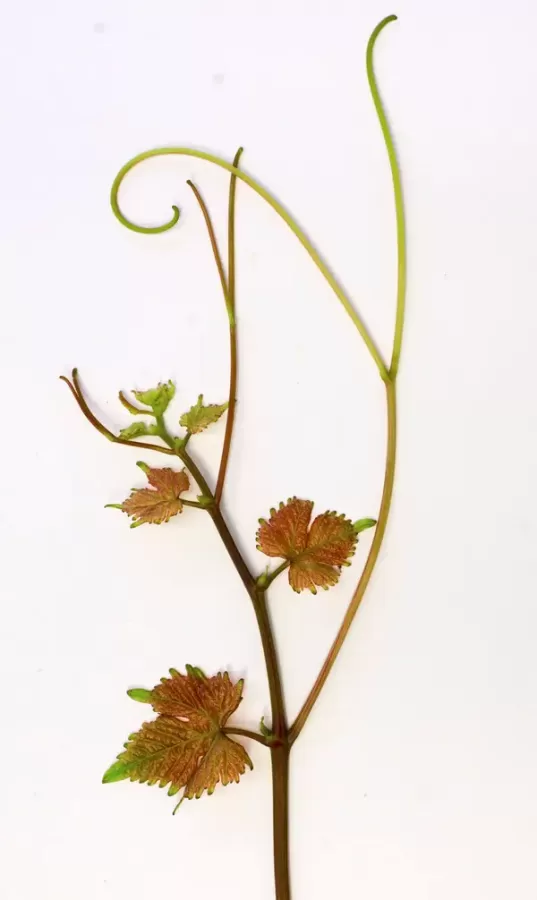
- Young shoot (shoot tip): The young shoot tip is wine-red and covered with comparatively dense cobwebby pubescence. Young leaves are bronze-colored and almost glabrous.
- One-year-old mature cane: Reddish-brown.
- Mature leaf: Medium-sized, round, five-lobed, moderately or deeply dissected, with downward-curving margins. Upper lateral sinuses are deep or medium-deep, open, less frequently closed, with a narrow-elliptical lumen; lower sinuses are of medium depth, predominantly open, lyre-shaped. The petiolar sinus is closed, with an elliptical or slit-like lumen, though open lyre-shaped sinuses also occur. Teeth at the lobe tips are triangular, acute, often with an elongated apex; marginal teeth are also triangular, with convex sides, often dome-shaped. Bristly pubescence is present along the veins on the lower leaf surface. Autumn leaf coloration is lemon-yellow.
- Flower: Hermaphrodite (bisexual).
- Cluster: Medium-sized (14–16 cm long, 8–9 cm wide), cylindrical-conical or conical, medium-dense or dense.
- Berry: Medium-sized (15–17 mm long, 15–16 mm wide), round, yellow-green, with a moderate waxy bloom (pruin), golden tint, and brown spots. The skin is thin but comparatively tough. The pulp is very tender and melting. The juice is colorless. The taste is pleasant, harmonious, without aroma. Each berry contains 2–3 small seeds.
- Saplings: With semi-prostrate shoots. Their leaves are mostly small, weakly dissected, three-lobed, with an almost closed petiolar sinus; the central lobe is slightly elongated, while the lateral lobes are raised with touching margins.
The leading distinguishing features of the Chasselas Blanc grape variety include deeply dissected leaves with a slightly elongated central lobe and downward-curved margins, an abundance of tendrils, reddish-bronze young leaves at the shoot tips, golden-green berries with brown sunburn spots on the sun-facing side, and lemon-yellow autumn leaf coloration.
Agrotechnical Features, Resistance, and Breeding Value
Vine vigor is medium, and one-year-old shoots mature well—up to 90%. The variety is characterized by stable high yields: at the Primorsky State Variety Testing Plot, plantings established in 1970 yielded an average of 7.2 t/ha during 1974–1979, while plantings established in 1962 yielded an average of 9.21 t/ha during 1966–1976 (ranging from 2.86 to 17.96 t/ha). The potential yield of the variety is 9.5 t/ha. Fruit-bearing shoots account for 62% of the vine, with an average of 0.9 clusters per developed shoot and 1.6 clusters per fruit-bearing shoot. A valuable biological trait is its high fruiting capacity on shoots developing from secondary (replacement) buds: in case of frost damage to the primary buds of overwintering eyes, 62–86% of a normal crop can be obtained from secondary bud shoots, whereas shoots from latent buds produce a very weak yield under Priazovye conditions.
The best results are achieved when cultivating the variety on warm slopes with loamy, sandy loam, shell-sand, and sandy soils. Recommended planting spacing is 1.25 m between vines in a row with row spacing of at least 2.5 m. Among trunkless training systems, a fan-shaped system with 4–6 fruiting units is most suitable, while high-trunk training systems can be used in the southern viticultural regions of Ukraine. To produce attractive table grapes, preference should be given to pruning to 5–7 buds (leaving shorter fruiting canes as plantings age). The most suitable rootstocks for the variety are Berlandieri × Riparia Teleki 8B and 5C, though Riparia × Rupestris 101-14, Kober 5BB, and Riparia Gloire are also suitable.
The variety is severely affected by spotted necrosis and downy mildew, susceptible to grey rot and crown gall, and damaged by phylloxera (a standard of weak resistance) and the European grapevine moth. Flower shedding and berry shot are insignificant. Chasselas Blanc belongs to varieties with medium frost resistance (over a six-year average, total bud mortality was 39.9% at frosts down to minus 17.5–23 °C) and possesses low drought resistance, responding well to irrigation. The antiquity of cultivation led to the formation of the Chasselas varietal type; the variety itself is homozygous for early ripening and white berry color (recessive homozygote), but heterogametic for flower sex, dominating in hybridization for low shoot vigor, medium cluster and berry size, round berry shape, and early ripening.