Gold Finger
| Variety Passport | |
| Country of origin: | Japan |
| Variety number VIVC: | 20070 |
| Prime name: | Gold Finger |
| Patent: | № 3406 MAFF Japan |
| Principal Synonyms: | Jin Shouzhi |
| Year of obtaining / registration: | Application filed in 1990, officially registered in the MAFF Plant Variety Protection Database (Japan) in 1993 |
| Pedigree given by breeder: | Peerless × Pizzutello Bianco |
| Species: | Interspecific hybrid |
| Ripening period: | Early |
| Classification and Use: | Table, Fresh consumption |
| Resistance group: | Moderately resistant |
| Data Sources: | Vitis International Variety Catalogue (VIVC), MAFF Plant Variety Protection Database (Japan), Henan Academy of Agricultural Sciences (HAAS, China) |




| Agrobiology | |
| Vigor: | Medium |
| Lateral shoot formation: | Strong |
| Flower type: | Hermaphrodite |
| Downy mildew susceptibility: | 3 points (tolerant) |
| Powdery mildew susceptibility: | 3 points (tolerant) |
| Winter hardiness: | Medium frost resistante (-21...-23°C) |
| Fertility coefficient: | 1,5 |
| Pruning length: | Medium, 5-8 buds |
| Clusters and berries | |
| Bunch shape: | Conical, Winged |
| Bunch density: | Loose, Medium |
| Average bunch weight: | 420 g |
| Berry shape: | Long, Curved |
| Berry skin color: | White |
| Average berry weight: | 6-7 g |
| Seed development: | Seeded |
| Flesh texture: | Juicy, Fleshy |
| Berry skin thickness: | Medium |
| Berry skin texture: | Medium |
| Sugar content: | 18-25% |
| Berry Flesh Color: | Non-colored |
| Flavor type: | Varietal |
| Ampelographic overview |
Main Characteristics
Gold Finger is an early- to early-mid-season table grape cultivar bred in Japan by Tomikazu Harada and Kazuo Harada (Kasugai, Yamanashi Prefecture) by crossing Peerless with Pizzutello Bianco. The plant variety protection application (No. 4182) was filed on December 7, 1990, and on March 10, 1993, the cultivar was officially registered in the MAFF Plant Variety Protection Database under Registration No. 3406 (the 18-year protection term expired on March 11, 2011). Genetically, it is an interspecific Euro-American hybrid.
In terms of ripening period, the Gold Finger grape cultivar is classified as an early-ripening variety: despite late blooming, harvesting at its place of origin (Yamanashi Prefecture) begins in mid-to-late August. According to five-year trials conducted at the Eastern Henan Experimental Station of the Henan Academy of Agricultural Sciences (Zhengzhou, China), the growing period from budbreak to berry maturity spans 120–130 days (budbreak on April 7, flowering on May 13, and ripening on August 12), corresponding to an early-to-mid-season ripening window.
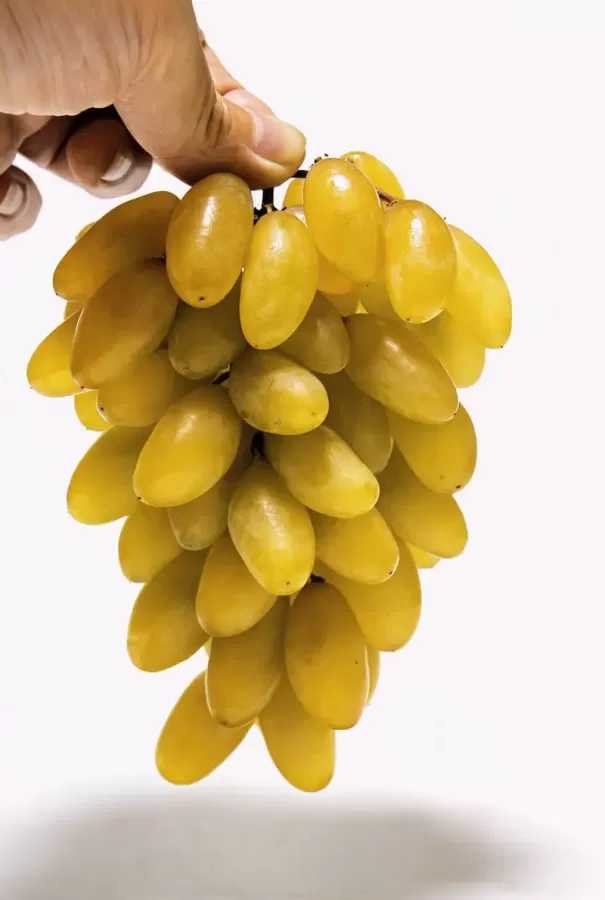
The cultivar produces large conical (elongated-conical) clusters with a wing (shoulder branch), ranging from loose to medium in density. Average cluster weight is 300–550 g (approximately 420 g according to the MAFF registry), with maximum cluster weights reaching 800 g. Berries are medium-sized, weighing 6.0–7.0 g, and feature a distinctive arcuate, curved (finger-like) shape that is thicker in the middle and tapered toward both ends (resembling Pizzutello Bianco). Skin color is yellow-white or yellow-green at technical maturity, developing an attractive golden-yellow hue at full ripeness.
The berry skin is thin to medium-thick and edible without astringency (skin separation from the flesh is rated as moderately difficult in the MAFF registry). The flesh is colorless, moderately juicy, and crisp (rated as intermediate in texture in the MAFF registry). The cultivar is distinguished by exceptionally high sugar accumulation: soluble solids reach 18–22% in yellow-green berries (around 18% in the MAFF registry) and exceed 20%, reaching up to 25%, in fully ripened golden-yellow fruit, paired with low titratable acidity. The flavor is very sweet and rich, with characteristic notes of rock candy and milk (classified as neutral, without muscat or foxy aroma, in the MAFF registry). Berries contain a small number (2–3) of large, elongated seeds.
Morphological Description of the Gold Finger Grape Cultivar
Based on combined data from the MAFF Plant Variety Protection Database (Registration No. 3406) and ampelographic evaluations by the Henan Academy of Agricultural Sciences, the Gold Finger cultivar exhibits the following morphological traits:
- Vine and Shoots: vines are medium to moderately vigorous, with medium-thick shoots and elongated internodes. Mature one-year-old canes are yellow-brown with a glossy surface. Dormant buds are medium-sized.
- Young Shoot (Tip) and Young Leaves: the tip of the young shoot is greenish-yellow; young leaves are light red with dense cottony pubescence.
- Mature Leaf: the leaf blade is pentagonal or circular-pentagonal, thick, and five-lobed (rated as slightly smaller than medium in Japan and large under the continental climate of China). The upper leaf surface is green without gloss; the lower surface is green. The petiolar sinus is widely open and brace-shaped. Upper lateral sinuses are deep and closed; lower lateral sinuses are shallow. Marginal teeth are acute. The petiole is pale reddish to purplish-red and short relative to the main vein.
- Inflorescence and Flower: inflorescences are large and borne on nodes 3 to 5 of the fruitful shoot (predominantly on nodes 3 and 4). Flowers are perfect (hermaphroditic). Blooming time is late.
- Cluster and Berry: clusters are conical (elongated-conical) with a wing, ranging from loose to medium-dense. Berries are curved and finger-shaped, turning golden-yellow at full maturity. Pedicel strength is medium, and mature berries detach easily from the pedicel.
Viticultural Characteristics and Cultivation
The Gold Finger grape cultivar possesses enhanced frost hardiness and good resistance to fungal diseases (as an interspecific Euro-American hybrid, it can be successfully grown in open-field vineyards under standard preventive disease control programs, though plastic rain shelters are recommended in regions with heavy rainfall to protect the crop). Resistance to berry skin cracking is moderate. Post-harvest shelf life is relatively short, and ripe berries detach easily from the pedicel, requiring careful handling during harvest and transport.
Fruitfulness is good: budbreak of primary buds in dormant eyes reaches 87.7%, averaging 1.5 inflorescences per fruitful shoot (typically 1–2 inflorescences). Because basal buds exhibit weak fruit bud differentiation while the highest-quality inflorescences develop on middle and upper nodes, winter pruning should follow medium-to-long cane pruning systems while leaving renewal spurs near the base of the cordons (on a double-cross V-trellis, target load is approximately 9 buds and 4.5 shoots per m², maintaining a 3:1 ratio of fruitful to vegetative shoots spaced 12–15 cm apart). Bearing begins early: yields reach approximately 0.45 kg/m² in the second year after planting and enter full production in the third year with an average yield of 1.87 kg/m².
The cultivar shows vigorous lateral shoot (summer lateral) growth that can cause excessive canopy shading; therefore, timely pinching of lateral shoots to 1–2 leaves is required during summer (main shoot topping and lateral pinching should be spaced at least one week apart to avoid forcing premature budbreak of dormant winter buds). Before bloom, the cluster wing is removed and the inflorescence is trimmed to achieve a compact cluster shape, followed by berry thinning two weeks after bloom to remove small and misshapen berries. Natural tendency toward flower shattering (coulure) is rated as moderate, with only a small proportion of parthenocarpic seedless berries in the cluster.