Kyoho
| Variety Passport | |
| Country of origin: | Japan |
| Variety number VIVC: | 6597 |
| Prime name: | Kyoho (4N) |
| Principal Synonyms: | Ju Feng |
| Year of obtaining / registration: | Obtained in 1935 |
| Pedigree given by breeder: | Centennial × Ishihara Wase |
| Species: | Interspecific hybrid |
| Ripening period: | Mid-season |
| Classification and Use: | Table, Fresh consumption |
| Resistance group: | Moderately resistant |
| Data Sources: | Vitis International Variety Catalogue (VIVC), INRAE (France), NARO Repository (National Agriculture and Food Research Organization, Japan) |


| Agrobiology | |
| Vigor: | Vigorous |
| Flower type: | Hermaphrodite |
| Downy mildew susceptibility: | 3 points (tolerant) |
| Powdery mildew susceptibility: | 3 points (tolerant) |
| Winter hardiness: | Medium frost resistante (-21...-23°C) |
| Pruning length: | Short, 2-4 buds |
| Recommended rootstocks: | Kober 5BB |
| Clusters and berries | |
| Bunch shape: | Conical |
| Bunch density: | Loose |
| Average bunch weight: | 194-426 g |
| Berry shape: | Obovoid |
| Berry skin color: | Black |
| Average berry weight: | 10,7-12,5 g |
| Seed development: | Seeded |
| Flesh texture: | Mucilaginous |
| Berry skin thickness: | Thick |
| Sugar content: | 17,5-19,3% |
| Total acidity: | 4,4-6,8 g/l |
| Flavor type: | Labrusca |
| Ampelographic overview |
Main Characteristics
Kyoho is a large-berried, tetraploid (4n) interspecific table grape cultivar of mid-season ripening with black (violet-black) berries, bred in Japan by Yasushi Ohinoue in 1935 by crossing Centennial (a tetraploid bud mutation of Dattier de Beyrouth) with Ishihara Wase (a tetraploid bud mutation of Campbell Early). The genetic profile of the cultivar has been identified across nine microsatellite loci (VVS2: 120/131/133; VVMD5: 229/234/247/249; VVMD7: 235/239/248/252; VVMD27: 176/182; VRZAG62: 186/204/254; VRZAG79: 238/244/257; VVMD25: 239/248/271; VVMD28: 224/229; VVMD32: 239/257).
In terms of ripening time, the Kyoho grape cultivar belongs to the mid-season group, reaching maturity three weeks after the reference cultivar Chasselas (comparable to Cabernet Sauvignon and slightly earlier than Grenache). Across different climatic zones of Japan, harvesting in seeded production takes place from mid-August in the south to mid-October in the north (the average harvest date across 31 test locations in Japan is September 9; August 30 at the Akitsu station in Hiroshima Prefecture; August 26 in Mie Prefecture; and the first ten days of October in Ibaraki Prefecture), whereas in seedless production with gibberellic acid application ripening is accelerated (averaging September 8 across 34 national trial sites, August 27 at Akitsu, and from mid-August in Aichi Prefecture).
The cultivar produces medium-sized conical clusters that are loose in seeded cultivation and loose to medium-dense under seedless management. In seeded production, average cluster weight ranges from 194 to 270 g (314–412 g in Ibaraki Prefecture), while in seedless production with flower cluster trimming it averages 374 g across national trial sites, 426 g at Akitsu, and 402.5–473.8 g in commercial vineyards in Aichi Prefecture. Berries are large to very large, obovoid or short-elliptic in shape, black (violet-black) in color, and covered with a heavy waxy bloom (pruin). Average berry weight in seeded cultivation is 11.1 g across 31 trial locations (ranging from 8.3 to 13.2 g) and 12.3–12.5 g in southern and central districts; in seedless production, berry weight averages 11.3 g nationwide, 12.4 g at Akitsu, and 10.7–13.0 g in Aichi Prefecture vineyards.
The berry skin is thick, separating easily from the flesh in seeded fruit and moderately in seedless fruit. The flesh is medium-firm and juicy, with a texture intermediate between breakable (European type) and firm/gelatinous (American type). Flavor is harmonious, free of astringency, and marked by a distinct foxy aroma. Soluble solids accumulation averages 17.5–18.9% (up to 20.2%) in seeded production and 18.5–19.3% in seedless production, with titratable acidity of 0.44–0.68 g/100 mL (4.4–6.8 g/L) in seeded fruit and 0.50–0.53 g/100 mL (5.0–5.3 g/L) in seedless fruit. Seeded berries contain an average of 1.5 to 1.6 seeds per berry.
Morphological Description of the Kyoho Grape Cultivar
According to ampelographic descriptions from the Plantgrape catalogue and reports of the NARO Institute of Fruit Tree Science, the Kyoho cultivar exhibits the following morphological traits:
- Vine and Shoots: vines are large and vigorous with a wide canopy and vigorous growth of long shoots. Growing shoots are green and red; mature one-year-old canes are dark brown.
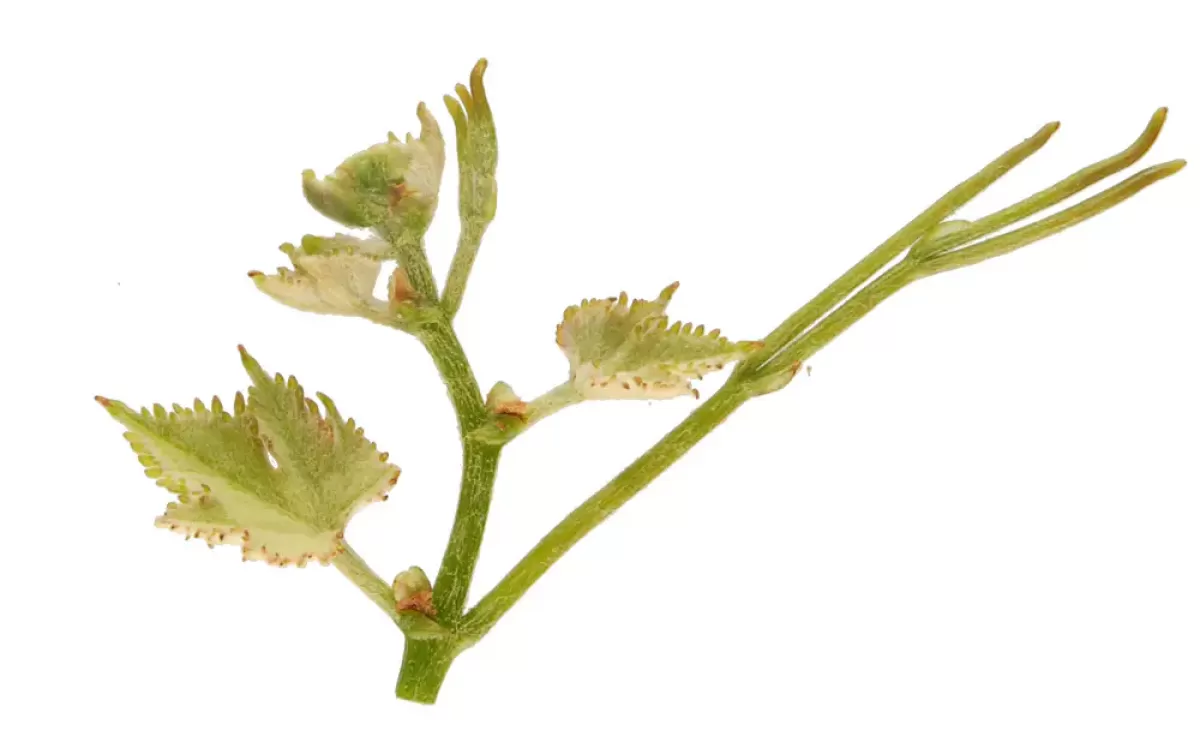
- Young Shoot (Tip) and Young Leaves: the tip of the young shoot has a moderate density of prostrate cobwebby hairs. Young leaves display bronze spots and a moderate density of prostrate hairs.
- Mature Leaf: the leaf blade is circular or wedge-shaped, flat, three- or five-lobed, with a finely blistered upper surface. Lateral sinuses are shallow. The petiolar sinus is open and brace- or U-shaped. Marginal teeth are small, long relative to their width at the base, with straight sides. Anthocyanin coloration of the veins is absent. The lower side of the leaf has a low density of prostrate hairs.
- Flowering Phenology: budbreak occurs at a mid-season date, 4 days after Chasselas (under Japanese conditions, averaging April 10 at Akitsu, April 16 across 34 national trial sites, and April 19–30 in Ibaraki Prefecture). Full bloom occurs in late May to early June (averaging June 2 at Akitsu and June 3 across 34 regions of Japan).
- Cluster and Berry: clusters are naturally conical and loose. Berries are obovoid or short-elliptic, violet-black, with a heavy waxy bloom.
Viticultural Characteristics and Cultivation
The Kyoho grape cultivar is characterized by strong vine vigor, good cold hardiness (surpassing Queen Nina and Pione in winter hardiness and serving as the standard of adaptation from central Tohoku southward), and compatibility with Teleki 5BB rootstock. Resistance to major fungal diseases—downy mildew, powdery mildew, and anthracnose—is moderate and higher than that of Vitis vinifera table grape cultivars; it also demonstrates high resistance to ripe rot (glomerella rot, outperforming Aki Queen, Pione, and Queen Nina), though minimal fungicide protection is necessary in seasons with high disease pressure.
In seeded cultivation, Kyoho is sensitive to flower shattering (coulure), which limits fruit set on overly vigorous shoots; heavy crop loads can result in uneven berry coloration. At full maturity, clusters are prone to berry shedding, and post-harvest shelf life at room temperature is short, averaging 4.8 days (overall storage capacity is rated as average). Resistance to berry skin cracking is high (none to very slight).
To stabilize fruit set, accelerate ripening, and achieve seedless fruit production (averaging 0.0–0.13 seeds per berry), inflorescences and clusters are widely treated twice with a 25 ppm gibberellic acid (GA) solution (first at early or full bloom, and second 10–15 days after full bloom) following pre-bloom trimming of the inflorescence to retain the apical 3 cm. In seedless cultivation, spur pruning to 2 buds yields optimal results: it provides 96% budbreak (compared to 77.2% with 8-bud cane pruning), uniform development of shoots measuring 50–90 cm pre-bloom (optimally 75–85 cm) and 70–120 cm pre-harvest (optimally 90–115 cm), good cane maturation, and minimal shoot dieback, supporting marketable yields of 1.5–2.0 t/10a (15–20 t/ha) at a crop load of 3,500–4,500 clusters per 10a (3.5–5 clusters per m²) and a shoot density of 10–15 shoots per m².
VINEYARD Note: The use of phytohormones in viticulture is widespread in Japan. Many cultivars are grown both in "seeded culture," which refers to the natural seed content characteristic of the cultivar, and in "seedless culture," where growers use gibberellic acid to achieve complete or near-complete seedlessness in the berries.