Queen Nina
| Variety Passport | |
| Country of origin: | Japan |
| Breeder: | NARO (Japan) |
| Variety number VIVC: | 24056 |
| Prime name: | Queen Nina (4N) |
| Patent: | № 20733 MAFF Japan |
| Year of obtaining / registration: | Crossed in 1992, seeds sown in 1993, planted in the selection vineyard in 1996, primarily selected in 2002, released in 2009, registered in the MAFF Agricultural Plant Varieties Register in 2010, officially registered under the Plant Variety Protection and Seed Act (MAFF) in 2011 |
| Pedigree given by breeder: | Budo Akitsu-20 × Aki Queen |
| Species: | Interspecific hybrid |
| Ripening period: | Mid-season |
| Classification and Use: | Table, Fresh consumption |
| Resistance group: | Moderately resistant |
| Data Sources: | Vitis International Variety Catalogue (VIVC), NARO Repository (National Agriculture and Food Research Organization, Japan), MAFF Plant Variety Protection Database (Japan) |



| Agrobiology | |
| Vigor: | Semi-vigorous |
| Flower type: | Hermaphrodite |
| Downy mildew susceptibility: | 3 points (tolerant) |
| Powdery mildew susceptibility: | 3 points (tolerant) |
| Winter hardiness: | Low frost resistance (-18...-20°C) |
| Pruning length: | Short, 2-4 buds |
| Recommended rootstocks: | Riparia Gloire de Montpellier, Kober 5BB |
| Clusters and berries | |
| Bunch density: | Loose |
| Average bunch weight: | 254-517 g |
| Berry shape: | Obovoid |
| Berry skin color: | Red |
| Average berry weight: | 14,7-17,6 g |
| Seed development: | Seeded |
| Flesh texture: | Firm / Crunchy |
| Berry skin thickness: | Medium |
| Berry skin texture: | Medium |
| Sugar content: | 20,6-21,7% |
| Total acidity: | 3,4-4 g/l |
| Flavor type: | Labrusca |
| Ampelographic overview |
Main Characteristics
Queen Nina is a large-berried, red-skinned tetraploid table grape cultivar of mid-season ripening bred in Japan at the Akitsu Branch of the Institute of Fruit Tree Science, National Agriculture and Food Research Organization (NARO, Higashihiroshima, Hiroshima Prefecture). The cultivar resulted from crossing the breeding selection Budo Akitsu-20 (Benizuiho × Hakuho) with the tetraploid cultivar Aki Queen (selfing of Kyoho). The cross was made in 1992, seeds were sown in 1993, and seedlings grafted onto Teleki 5BB rootstock were planted in the selection vineyard in February 1996 under individual number 380-4. It first fruited in 1997 and underwent primary selection in 2002. Starting in 2004, under the breeding line designation Budo Akitsu-27, the cultivar was evaluated in the 11th Grape Selection National Trial across 37 research institutions in 34 prefectures of Japan.
The cultivar was released in 2009, registered in the MAFF Agricultural Plant Varieties Register in April 2010, and officially registered on March 18, 2011, in the MAFF Plant Variety Protection Database under Registration No. 20733 (Application No. 23912, filed July 15, 2009). The multi-year trial results were published in the Bulletin of the NARO Institute of Fruit Tree Science (No. 15, pp. 21–37, 2013).
The Queen Nina grape cultivar ripens from late August to early September, averaging 5 to 7 days later than Kyoho and 4 days later than Pione: at the Akitsu research station over a five-year observation period (2004–2008), the average harvest date was September 1 (compared to August 27 for Kyoho and August 28 for Pione), whereas across 34 national trial sites the average harvest date was September 15 (late August to early September from the Kanto region westward, and late September to the first ten days of October in Nagano Prefecture, the Tohoku district, and Hokkaido). In seeded production (based on trials in Mie Prefecture), the average cluster weight is 254 g and average berry weight is 15.0 g (averaging 1.1 seeds per berry). Under seedless cultivation with two gibberellic acid applications, the cultivar produces loose to medium-density clusters averaging 442 g across national trial locations (ranging from 287 to 678 g) and 517 g at the breeding station, with an average berry weight of 14.7 g nationwide (ranging from 10.6 to 20.8 g) and 17.6 g at Akitsu.
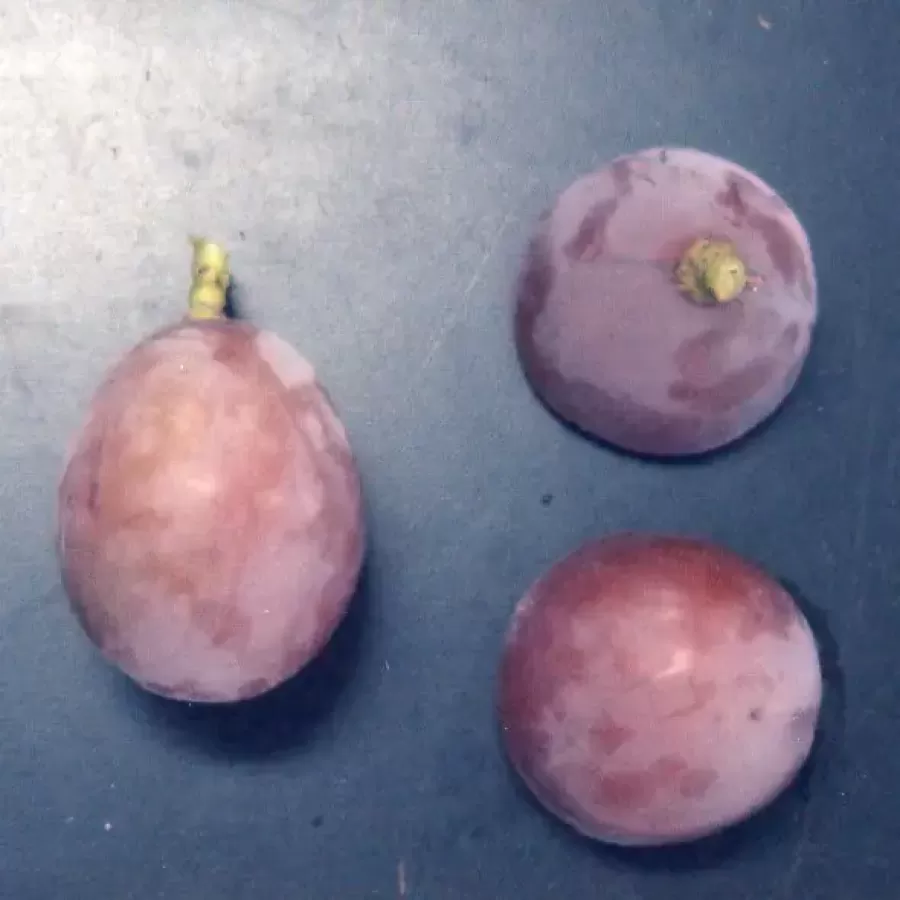
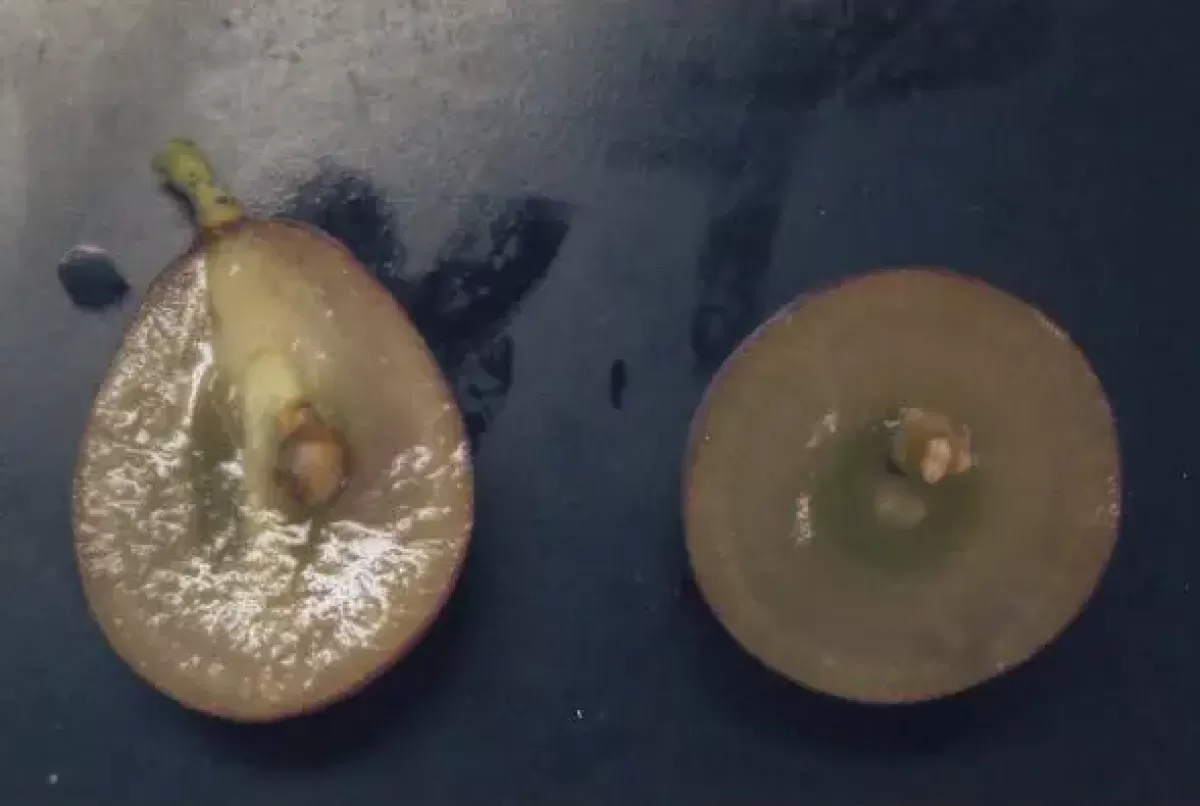
The berries are obovate, bright red in skin color, and covered with a heavy waxy bloom (pruin). Skin thickness is medium, and separation of the skin from the flesh is medium to moderately difficult (comparable to seedless Kyoho and Pione); slight astringency may be perceived at the boundary between skin and flesh under certain conditions if the skin is chewed, whereas the flesh itself is completely free of astringency. The flesh is firm, crisp, and of the breakable type (similar to Vitis vinifera table grapes, unlike the intermediate flesh texture of Kyoho and Pione) as well as very juicy. The cultivar exhibits high soluble solids accumulation—averaging 20.6% nationwide and 21.7% at Akitsu (about 2% higher than Kyoho and Pione)—paired with low titratable acidity averaging 0.40 g/100 mL (4.0 g/L) nationwide and 0.37 g/100 mL (3.7 g/L) at Akitsu (20.6% Brix and 3.4 g/L acidity in seeded production in Mie Prefecture). Eating quality is outstanding, harmonious, and characterized by a pleasant, mild foxy aroma.
Morphological Description of the Queen Nina Grape Cultivar
According to data from the MAFF Plant Variety Protection Database (Registration No. 20733) and the NARO Institute of Fruit Tree Science report, the Queen Nina cultivar displays the following morphological traits:
- Vine and Shoots: vine vigor ranges from medium to strong (moderately vigorous; rated as vigorous in 4 out of 5 years at Akitsu and at 13 national trial sites, though vigor becomes slightly weaker than Kyoho and Pione in older, mature vines). Mature canes are dark brown.
- Young Shoot (Tip): apical leaves of the young shoot are fully open, with medium-density pubescence and no anthocyanin coloration of the hairs.
- Mature Leaf: the leaf blade is medium-large (moderately large), pentagonal, and five-lobed. The petiolar sinus is widely open. The upper lateral sinuses are deep and closed (with overlapping lobes). Marginal teeth have straight sides (rectilinear).
- Inflorescence and Flower: natural inflorescences are long. Flowers are perfect (hermaphroditic). Budbreak and flowering occur slightly later than in Kyoho and Pione: at Akitsu, budbreak occurs on average on April 15 (5 days later than Kyoho and 13 days later than Aki Queen), and full bloom occurs on June 6 (4 days later than Kyoho and 6 days later than Aki Queen); across 34 national trial sites, average budbreak was recorded on April 18 and full bloom on June 5.
- Cluster and Peduncle: clusters in seedless production are loose to medium-dense (naturally loose). The peduncle is very long and green. Resistance of ripe berries to shattering during handling and storage is easy to medium, similar to Kyoho and Pione.
Viticultural Characteristics and Cultivation
The Queen Nina grape cultivar is adapted to Kyoho-growing regions from the southern Tohoku district southward to Kyushu. Its cold hardiness is lower than that of Kyoho: under cold winter conditions with little or no snow cover (such as in Kitakami, Iwate Prefecture), bud failure and vine winterkill were observed. Conversely, in northern regions with heavy snowfall (Hokkaido and Aomori Prefecture), vines overwintered under snow cover in unheated plastic houses fruited successfully, and berry acidity dropped to 0.42–0.77 g/100 mL (lower than Kyoho and Pione under the same conditions). Under conventional pest and disease management programs used for Kyoho, no severe disease incidence was observed; laboratory and field evaluations indicate moderate resistance to anthracnose (comparable to Kyoho), while susceptibility to ripe rot (Colletotrichum acutatum) is higher than in Kyoho and similar to Pione and Aki Queen.
The cultivar is compatible with Teleki 5BB and Riparia Gloire rootstocks, demonstrates reliable fruitful bud differentiation, and is well-suited for both spur pruning (successfully evaluated under spur pruning at 17 test locations) and cane pruning. Although natural tendency toward flower shattering is high, berry set under seedless cultivation is good (comparable to Kyoho and Pione). To achieve seedless fruit production (averaging 0.0–0.06 seeds per berry), inflorescences and clusters are dipped twice in a 25 ppm gibberellic acid (GA) solution (first from full bloom to 3 days after full bloom, and second 10–15 days after full bloom), optionally combined with streptomycin (200 ppm pre-bloom) or forchlorfenuron (3–5 ppm). Before bloom, flower clusters are trimmed to retain the apical 3.5–4 cm; when thinning berries on a rachis approximately 8 cm long, around 28 berries are retained to achieve a target cluster weight of about 500 g (requiring less labor for berry thinning than Kyoho, Pione, and Aki Queen).
Overall resistance to berry skin cracking is high (none to slight), though moderate cracking (10–20%) was recorded in certain years and locations under high moisture or excessive berry enlargement; berry shrivel (physiological disorder "shukukasho") was also noted at several trial sites. Post-harvest shelf life at room temperature is short, averaging 5.8 days (ranging from 3.0 to 10.6 days), which is comparable to Kyoho (4.8 days) and Pione (5.5 days). To attain rich, bright red skin coloration, growers must control the leaf area index (avoiding excessive canopy shading), ensure good sunlight exposure to the clusters, and restrict crop load: average berry weight should be maintained at around 15 g, cluster weight below 500 g, and total yield at approximately 1.2 t/10a (12 t/ha), as excessive foliage causes prolonged berry enlargement to oversized dimensions accompanied by poor coloration and increased cracking.