Taezhnyi Izumrud
| Variety Passport | |
| Country of origin: | USSR |
| Breeder: | Primorsky Fruit and Berry Experiment Station (FSC FE) |
| Variety number VIVC: | 12195 |
| Prime name: | Taezhnyi Izumrud |
| Principal Synonyms: | Seyanets Tikhonova No. 9, Seyanets Minnesota |
| Year of obtaining / registration: | selected in 1936, included in the standard |
| Pedigree given by breeder: | Seedling Of The American Hybrid Variety Minnesota |
| Species: | Interspecific hybrid |
| Ripening period: | Mid-season |
| Classification and Use: | Dual-purpose, Fresh consumption, Juice Production |
| Resistance group: | Complex resistant |
| Data Sources: | Vitis International Variety Catalogue (VIVC), Виноград на Дальнем Востоке (Л. Я. Лебедева изд. 1989) |


| Agrobiology | |
| Vigor: | vigorous |
| Flower type: | hermaphrodite |
| Downy mildew susceptibility: | 1 point (highly resistant) |
| Winter hardiness: | High frost resistance (-24...-26°C) |
| Rooting ability: | medium |
| Pruning length: | mixed / Guyot |
| Clusters and berries | |
| Bunch shape: | cylindrical, cylindro-conical |
| Bunch density: | medium, dense |
| Berry shape: | rounded |
| Berry skin color: | white |
| Seed development: | seeded |
| Flesh texture: | mucilaginous |
| Berry skin thickness: | Thick |
| Berry skin texture: | tough |
| Flavor type: | Labrusca |
| Ampelographic overview |
Main characteristics
Taezhnyi Izumrud is a seedling of the American hybrid variety Minnesota. It was selected in 1936 by N. N. Tikhonov at the Primorsky Fruit and Berry Experimental Station and was included in the standard assortment for the Primorsky Krai in 1947. The variety is distributed in home vineyards and is consumed fresh. In literature, it is also known under the names Seyanets Minnesota and Seyanets Tikhonova No. 9.
The ripening period of the Taezhnyi Izumrud grapevine variety is medium. Full maturity of berries occurs in the last days of September. In the South-Coastal zone, the decrease in juice acidity continues until October 3–5. Marketable and gustatory qualities strongly depend on the bush illumination. The yield is high, amounting to 50–60 c/ha. When fully ripe, it has a pleasant taste with a distinctive strawberry aroma characteristic of Vitis labrusca. The overall tasting score of fresh grapes is 6–7 points on a ten-point scale. Transportability is completely satisfactory.
Morphological description of the Taezhnyi Izumrud grapevine variety
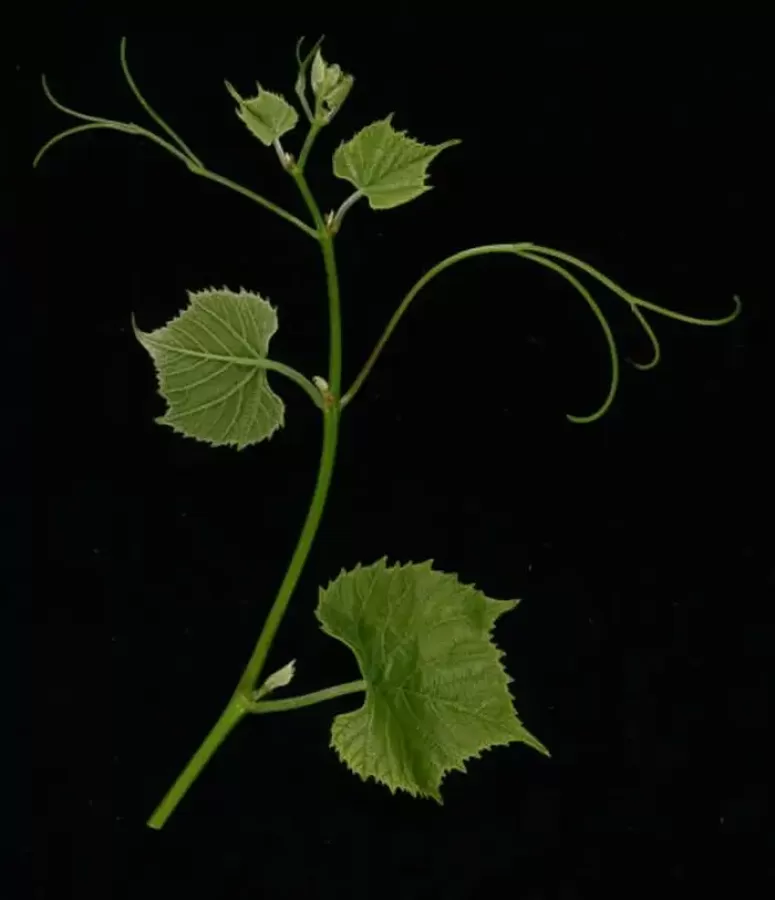
- The shoot tip (young shoot) and the first young leaves are covered with dense, grayish-white felt-like pubescence.
- The mature annual shoot is dark brown (chocolate tone) in color. The nodes are colored more intensely. Shoot maturation is good.
- The leaf is large, round, three-lobed, weakly cleft, almost entire. The leaf blade is almost flat or slightly folded, leathery. The upper surface of the leaf is smooth, dark green, shiny; the lower surface is dull green, covered with dense short bristles along the veins. Lateral sinuses are small, open. The petiolar sinus is open, sagittal, deep, often wide.
- The flower is hermaphrodite.
- The bunch is of medium size, cylindrical, sometimes cylindrico-conical, of medium density and dense. Unevenness of bunches in size and density within the bush is noted. The bunch stem is short, green.
- The berry is medium, round, light green, with a golden tint on the sunny side and translucent pulp. It is covered with a weak waxy bloom. The skin is thick, firm, coarse, separating well from the pulp. The pulp is mucilaginous, with a large core around the seeds.
Features of agrotechnics
Bush growth is vigorous. The Taezhnyi Izumrud grapevine variety is characterized by high frost resistance of both the aboveground part of the bush and the root system. It overwinters under a 15–20 cm layer of soil. Cuttings root worse than those of the Alpha variety. It poorly tolerates waterlogging of the soil. It is highly responsive to soil fertility and fertilization with mineral and organic fertilizers.
On rich alluvial soils, a longer pruning of fruiting canes for 12–16 buds is required; on dry and stony soils, a short pruning for 8–10 buds is necessary. In the Primorsky Krai, it is resistant to downy mildew (mildew). In spring, the opening buds and inflorescences are damaged by the bud weevil. It is recommended as a main variety in all zones of the Far East for fresh consumption in self-rooted culture.